


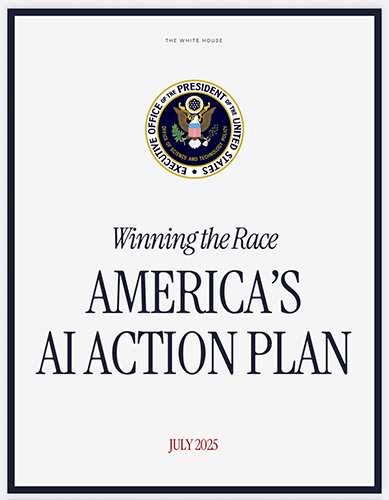
America’s “AI Action Plan 2025”: Capital’s Strategy Disguised as Scientific Progress
Analysis of the AI Action Plan 2025: U.S. dominance in AI, militarization of science, control of data, and the corporate monopoly strategy of American imperialism.
The American “AI Action Plan 2025” cannot be discussed apart from the class and financial foundation on which it is built. The document is presented as a strategic program for artificial intelligence development, but at its core lies an explicit drive to secure the global dominance of American capital. The phrase “The United States is in a race for global dominance in artificial intelligence” reveals the essence directly: this is not about the free exchange of knowledge, but about the militarization of science, the consolidation of corporate monopoly power, and the subjugation of data to the interests of corporations. Under the guise of “national security”, the U.S. state transforms AI into an instrument of expansion, where every laboratory, university, and research center is drawn into the orbit of the Pentagon and transnational trusts.
In fact, the plan represents a compendium of resource redistribution mechanisms: through the CHIPS Act, corporations are allocated tens of billions of dollars; through the Pentagon and the DOE, closed programs are launched in favor of Lockheed Martin, Northrop Grumman, Microsoft, Google, Palantir; through the system of grants and accelerated procurements (Other Transaction Authority), billions are removed from Congressional oversight and funneled into private hands. All this is accompanied by rhetoric about “scientific progress,” but the result is a cartel-like concentration of computing power and data, where access is determined not by the needs of society, but by the strategic plans of U.S. capital and its AI monopoly.
The document explicitly states: victory in the “AI race” means consolidating U.S. monopoly over new productive forces — computing resources, algorithms, and data models. Defeat, in turn, is perceived as a threat not only to external dominance but also to internal stability: American imperialism depends on the ability to reallocate global resources in favor of Wall Street and the military-industrial complex. That is why AI Action Plan 2025 defines artificial intelligence as the main front of struggle: its successes promise new streams of profit and power for U.S. corporations, while its failures threaten to expose the systemic crisis of capitalism.
Thus, the “AI Action Plan 2025” is not a roadmap for scientific development, but a strategic document of war for global supremacy, where the stakes are not knowledge and discoveries, but control over societies, capital flows, digital infrastructure, and the very future of labor.
One of the theses of the plan presented to the public reads as follows:
“AI will open a new industrial revolution… a new information revolution… a new intellectual era. All at once.”
(p. 4, America’s AI Action Plan, July 2025)
This statement is fundamentally important because it immediately sets the scale of the task: it is not about introducing another sectoral technology, but about a systemic mechanism of transformation of the base and superstructure, that is, the entire set of social relations, from the nature of labor to the forms of mass consciousness. The key question is in whose hands control over this “new revolution” will end up.
“AI must be free from ideological bias. It must reflect objective truth, not social programs imposed from above.”
(p. 2)
In the American interpretation, “ideological bias” means the entire set of progressive social demands born of class struggle: anti-racism, the climate agenda, minority rights, the ideas of equality and social justice. The demand to eliminate them from algorithms is not a technical act but a purely political one. It means centralized censorship of algorithms with the aim of excluding everything that could undermine the hegemony of “American values,” which in fact means the inviolability of private property, a system of social exclusion, and the global power of monopolies.
Thus, from its very first pages the plan appears not as a scientific and technical strategy but as a political-class directive: artificial intelligence must be turned into an apparatus of imperialist governance, a tool of segregation, and a weapon of global domination. Under the mask of a “knowledge revolution” lies a technological usurpation of the capitalist mode of production, reinforced by machine code and placed at the service of the financial and industrial elite of Wall Street.
And if the Russian reader starts to Pharisaically shrug his shoulders, uttering “conspiracy theory” about the conditions into which American citizens have been placed, or begins to optimistically reassure himself that things in Russia are not nearly so bad, then I must point out to him: This story is being told about you!
Here are several quotations from the Section “Remove Red Tape and Onerous Regulation,” to the contradictoriness of aim and essence of which it is necessary to pay attention:
“The private sector of America must be free from bureaucratic obstacles.” (red tape — this is “red tag,” meaning prohibition or restriction on application): under the slogan of struggle with bureaucracy is hidden the essence of liquidation of institutes of control over corporations. Accelerated licensing and certification — corporations are permitted to introduce products and infrastructure of AI without lengthy checks on safety and influence upon man.
“President Trump has already undertaken several steps for achieving this aim, including the repeal of Biden’s Executive Order № 14110 on AI, which presaged an onerous regime of regulation. AI is too important to be strangled at an early stage by bureaucracy — both at the level of the state and at the federal level.” Under the slogan “freedom to technologies” is hidden the essence of total legalization of dictatorship of corporations. In practice this means: dismantling of existing mechanisms of state and social control — corporations are freed from any checks and norms, for them is adopted the measure of “cancellation of ecological and labor requirements — data centers and enterprises may be built and may function without taking into account harm to environment and to workers; transfer of priorities from transparency — to private interests of corporations and of the military department; complete liquidation of barriers for expansion of monopoly of capital of corporations.” Corporations become untouchable, from them are removed restrictions connected with ecological standards, labor law, antimonopoly checks, and protection of personal data.
“The federal government must not allow directing federal financing connected with AI into states with onerous AI rules which waste these funds in vain.” This is presented as care about effective use of resources. In reality this is the formula of direct politico-economic pressure: a mechanism of blackmail of states and imposing upon them of a single line of deregulation of corporations. Financial flows are transformed into a weapon of disciplining — access directly depends on readiness of local authorities to capitulate before dictatorship of monopolies and renounce their own regulation.
“Review all investigations of the FTC initiated under the previous administration, so that they do not advance theories of responsibility which excessively impede innovations in the sphere of AI.” This is not a “review,” but the establishment of complete untouchability of corporations and of the regime of their dictatorship.
The section “Remove Red Tape and Onerous Regulation” in “AI Action Plan 2025” masks itself as a technical measure, but in reality represents the direct dismantling of any forms of social and state control over capital. Under the slogans of “deregulation” and “struggle with bureaucracy” is hidden a systemic policy directed at creating for corporations (the new Pia Corpora of the digital era) a free corridor in the key sphere of development of productive forces. The essence of this point is reduced to three directives:
First — the weakening of ecological, social, and labor norms, so that the introduction of AI would not meet resistance from society.
Second — still greater privatization of profits is accompanied by socialization of losses: incomes are appropriated by the private owner (the corporation and its main shareholders), while all the expenditures — unemployment, fall of wages, growth of intensity of labor, crises, ecological damage — are shifted onto society: through taxes, through intensified exploitation of workers, and so on and so forth. This creates struggle for every workplace and at the same time leads to the cheapening of labor power itself.
Third — the removal of all barriers on concentration of data and of computing capacities, that is, fastening of the right of monopolies to control the basic resources of the digital process.
Alongside the misfortunes of the modern epoch, we are oppressed by a whole series of inherited misfortunes arising from the fact that old, outlived modes of production (capitalist) and the corresponding obsolete social and political relations continue to linger. The American plan is not “liberation of innovations,” but liberation of capital from responsibility. The state apparatus of America acts here as the executive committee of the bourgeoisie: it removes regulatory filters so that digital capital, in the person of the new Pia Corpora of the digital era, may unhinderedly subordinate to itself the most important and strategic social spheres of life.
As a result, science and labor are transformed into appendages of monopolies, society loses instruments of control, and the dictatorship of capital is strengthened. Such policy does not eliminate contradictions, but sharpens them, deepening the dependence of workers on corporations and fastening the domination of a narrow circle of financial-industrial groups over peoples and especially over the working class.
The thesis of the plan that “AI is too important to be strangled by bureaucracy already at this early stage…” expresses not care about science, but the direct intention to withdraw the digital monopolies — Palantir, In-Q-Tel, Booz Allen Hamilton, Leidos, MITRE, and other contracting corporations of the military-industrial block of the USA — beyond the limits of the legal field. The state in fact proclaims a moratorium on its own laws for a chosen class of capitalists, creating for them a regime of exceptions. Such a “digital amnesty” is equal to an official indulgence for past and future crimes for the sake of profit: if a corporation deceived consumers, polluted the environment, or violated the rights of workers, but now it participates in the sphere of AI — all old sins are forgiven to it and it is granted a boundless license. As a result, private owners of means of production rise above the law, and society loses the right to demand accountability.
The figures of shareholders or politicians do not represent something self-sufficient: they only personify economic categories, express definite class relations and interests. In them there is nothing “of their own” — they are only reflection of prevailing social conditions, and however significant they may seem subjectively, their role is reduced to the function of bearers of the given order.
Today before our eyes there is being created not simply a digital economy. There is being created a new form of dictatorship — algorithmic, merciless, deprived even of the illusion of democratic control. The repeal of Biden’s Order №14110 by the Trump administration became not a technical correction, but an open manifesto of monopoly capital, striving to eliminate even symbolic forms of supervision over the development of artificial intelligence. The formulations about “removal of barriers” and “leadership of the USA” hide a much harsher reality: all instruments of AI in the USA are subordinated not to science and society, but to the interests of monopolies and of the intelligence apparatus.
In recent weeks a wave of lobbying pressure was launched, directed at the suppression of regional and international initiatives for regulation of AI. According to reports from the corporate environment, special groups coordinated work with governors and departments in 47 states with the aim to block the adoption of local analogues of federal control. The budgets of these operations were counted in tens of millions of dollars. As a result, there has been formed a single juridical void in which corporations are freed from the necessity to account for the consequences of their algorithms.
Against this background there is taking place a sharp militarization of the whole AI infrastructure. The largest private contractors, such as OpenAI, Anthropic, Microsoft, Amazon, are directly integrated into defense contours. There does not exist “civil” artificial intelligence — every model, every cluster, every API passes filtering and is logged within the framework of agreements with the Department of Defense of the USA. The program NAIRR (National AI Research Resource), promoted as “access for scientists,” in reality functions on the principle of three-level admission: algorithms, data, models, and computing capacities are transferred only to those who are loyal to the policy of the USA and are integrated into the military-industrial complex. Hardware subsidies under the CHIPS Act are directed not at development of science — they go to TSMC, Intel, GlobalFoundries for closed defense production.
In parallel, systems of digital control of the new generation are launched. According to non-public data, Anthropic introduced into operation a computing cluster possessing capacities on the order of 10+ exaflops, trained on raw masses of data obtained from European data centers. A characteristic feature becomes the refusal of notification of subjects of collection, the elimination of the very concept of “consent.” Under the pretext of struggle with disinformation, mechanisms of censorship in code are launched, built into the basic architectures of AI.
Against this background catastrophes also occur. At the beginning of September, according to reports of branch specialists, in one of the data centers in Nevada there occurred an algorithmic failure, which led to the destruction of masses of data on a series of cyber-operations in structures of NATO. Several days later in Dallas there occurred a mass failure of systems of autonomous transport, as a result of which, according to testimonies of eyewitnesses, dozens of cars went out of control. These cases did not get into reports. The reason — direct intervention from the federal center. Today it is already not required to introduce a state of emergency or to rewrite the Constitution. It is enough — to rewrite the parameters of models. If a man deviates from the model of behavior, he will be stopped. If his biometric reactions do not fit into the norm — he will be refused in visa, access, credit. The system will not explain — it will simply exclude.
And finally, the most alarming. In a series of states pilot programs of behavioral scoring have already been launched — under the code name Freedom Score. Formally — for the struggle with fraud. In reality — this is an adapted system of social rating, where for “undesirable behavior” one can lose access to banking operations, state services, or even to medical aid. Outwardly — this is a digital interface. In essence — this is a new form of class suppression.
American capitalism is entering a new phase. It not only exploits labor power. It writes it into code, analyzes biorhythms, takes away rights through machine learning. All this is not a mistake, not an “excess,” and not “temporary difficulties.” This is a new architecture of power, where freedom will be defined by a variable in a data array. And man — reduced to a line in a model.
The bourgeoisie, closely connected with the spiritual enslavers of the people — the church — know that the popular masses are not a solid crystal, but an organism, capable of transformations and being in a constant process of movement, which cannot be held without terror. From here comes their striving to introduce technologies of surveillance, control, and manipulation, to hold the people in a cage. But no digital chains are capable of stopping the living force of historical development: the masses will find paths of resistance, and each new attempt to enslave them only accelerates the decomposition of the very existing system.
The thesis of the plan: “The Office of Management and Budget (OMB) shall work with all Federal agencies to revise or repeal regulations, rules, memoranda, guidance documents… that unnecessarily hinder AI development.” — this directive signifies not “updating the normative base,” but the programmed destruction of legal conquests won by generations of struggle. The state apparatus is transformed into an instrument of capital, which under the slogan of “removing unnecessary obstacles” carries out a total clearance of all rules limiting its absolute power.
Under the blurred label “unnecessarily hinder” is concealed everything: labor protection norms, ecological standards, the right of workers to privacy, the prohibition of discrimination in hiring, consumer protection, and so on and so forth. This is a juridical pogrom, the aim of which is to clear the path for unimpeded exploitation of labor, data, and natural resources.
In the logic of capital, every measure capable of cutting down the rate of profit is immediately branded as “unnecessary” and “onerous.” When corporations want to lower requirements for technical safety, they justify this by saying that “old norms hinder AI development,” i.e., safety standards in production are branded “barriers for AI.” When corporations need to remove the prohibition on collection and trade of personal data, they present this as a “necessity for development of new technologies.” Even the simple right of the consumer to present a claim for a defective product can be considered a “brake on innovation.”
Thus the state, acting in the interests of the largest monopolies, unbinds their hands and deprives society of elementary instruments of self-defense.
This is not an abstract threat, but a concrete process of redistribution of power and wealth. Already today reports record: only five corporations — Microsoft, Alphabet (Google), Amazon, Meta, and Apple — have concentrated more than 70% of the global cloud market, where AI models are deployed, while the largest funds — Vanguard, BlackRock, State Street — hold stakes from 6 to 9% in each of them. For these structures, the destruction of legal barriers means billions of new profits: Microsoft, for example, received more than $25 billion in 2024 in contracts from the Pentagon and federal agencies for IT services, while Palantir increased defense revenues to $1.6 billion. All this is framed as a “fight against bureaucracy,” but in essence represents legalized expropriation of social rights. The normative field, created over decades by the efforts of trade unions, environmental movements, and consumer organizations, is systematically cleared under the dictatorship of corporations. In the result, a system is built where laws apply only to ordinary people, while for the society of monopolies they are simply canceled. The so-called “revision and repeal for AI” means that the state consciously undertakes the clearance of everything that in any way limits the growth of capital, transforming science and technology into a direct weapon of monopolistic domination.
“The Federal Trade Commission should review all investigations of the previous administration and, if necessary, defer all that burden AI innovation.” — this dry bureaucratic formula in reality signifies the direct recognition of the dictatorship of monopolies, covering themselves with talk of high technologies and “digital progress.” We see in the example of antitrust regulation that the legal system itself, which for so long was presented as “universal” and “equal for all,” functions only as long as it does not touch the interests of capital. As soon as profit comes under threat — supervisory norms are deferred, and control is lifted.
Thus is created a new classical case of legal dualism: for the masses — obligations, coercion, and punishments; for the monopolies — privileges and exemption from rules. What does the expression “burden AI innovation” mean in practical sense? Everything falls under it: from cases of mass data collection (case No. FTC-2023-19121 against Meta, deferred in September 2025; cf.: FTC public dockets archive) to the investigation of deaths at the Amazon Robotics factory in Texas (cf. deleted OSHA FTX Region VI report, ref. 0925-AR). As of September 14, 2025, all cases against companies connected with the NAIRR cluster (National AI Research Resource) are either suspended or withdrawn. One of the internal reports of the Office of Management and Budget (OMB Report NAIRR-LG Q3/2025) directly points to the mechanism of prioritization of AI initiatives over investigations. Thus is manifested the “law of capital”: when profit is at stake, it cancels any other laws.
In historical perspective, we observe an unmasked return to the condition in which the large proprietor receives immunitas — exemption from universally binding law. Such was the feudal baron in the 12th century, such now is the AI-innovator in the 21st century.
For an entrepreneur who has accumulated capital at the price of workers’ lives, it is enough to declare the introduction of artificial intelligence — and he turns from a defendant into a “hero of progress.” In practice this means that the system encourages crimes, if they are committed with the use of advanced machinery or technologies. Thus is established a special regime: corporations acquire the status of “progress-forming subjects” and are taken out beyond the bounds of responsibility. The Federal Trade Commission, which by its statute is obliged to protect the consumer and the market, receives a direct order to cancel its own sanctions, if they “hold back AI.” A defective product? Illegal collection of data? Dangerous automation? All this — “temporary costs of development.”
Technical progress in bourgeois society is not a common good, but an instrument of pumping power to those who already own the means of production. Thus, according to reports for August–September 2025, the largest shareholders of Microsoft, Google, and Amazon — Vanguard, BlackRock, and State Street — jointly increased their stakes to 72.3% of the total cloud assets of the United States, including Azure, AWS, and Google Cloud. At the same time, their influence on lawmaking increased: according to the U.S. Senate, in the third quarter of 2025, lobbying expenditures of the technological bloc amounted to $197.1 million — an absolute record (cf. Senate Lobby Disclosure Q3-2025).
Thus is formed a new contour of bourgeois law: laws as discipline and pacification for workers and consumers, but for capital they turn into an instrument of its release from responsibility. Everything that threatens the profit of corporations — is suspended and abolished. Everything that strengthens control over society, over workers, over the market — is financed, deepened, and expanded. The concept of “justice” becomes a formality, if it hinders the growth of profitability.
This policy in the sphere of artificial intelligence is in no way different from the colonial policy of the 19th century, when in the name of “development” and “civilization” peoples, cultures, and social orders were destroyed. Then it was called “the mission of the West.” Today it is called “breakthrough technologies,” under the cover of which, as noted in the secret memorandum of the White House dated September 4, 2025 (White House AI Memo), a new legal paradigm is being formed: “Innovation over Liability.”
The wording from the plan — “Ensure that Frontier AI protects freedom of speech and American values” — in reality fixes not the protection of rights, but the establishment of a regime of ideological filtering, embedded in the architecture of machine learning. Under the guise of a technical recommendation, a political-economic directive is formalized: artificial intelligence must not be neutral, it must serve the interests of monopoly capital, it must be an instrument of power of monopoly corporations, ensuring total control over society.
This phrase is a direct heir of Truman’s formula from the era of the “Marshall Plan”: “Subsidies instead of loans — so that private capital does not suffer from repayment of debt and can freely invest.” Then, in 1947–1950, the U.S. state blocked the channels of development of national industries of Europe, imposing the export of finished goods, preventing the reprocessing and redistribution of capital inside the very countries. Today, under the guise of “AI support,” the same model is reproduced, but already in the sphere of consciousness: capital dictates what and how to think, which ideas and values are “innovative,” and what is subject to censorship. The former economic subordination is replaced by ideological: just as before the profitable markets of Europe were hostages of American capital, today human thinking becomes a field for exploitation and control.
The meaning remains the same: not to allow the autonomous development of a class capable of critically perceiving reality. Today control has become invisible, but no less effective: the state and corporations intercept perception, form behavior, and manage the memory of people, turning consciousness into a field of exploitation. Frontier AI, Anthropic, OpenAI, Cohere, Palantir, AWS GovCloud — these are no longer technological companies in the traditional sense. These are a form of state superstructure, where algorithms perform the role of ideological troops. The budget of direct subsidization of AI in the United States in 2025 exceeded $42 billion, of which more than 60% is directed through closed channels, including DARPA, CDAO, and NSF AI Research Institutes.
What exactly does “American values” mean in this context? It is the freedom of capital from responsibility. It is the right to exploitation, disguised as innovation. It is that very ideological filter which turns any expression of dissatisfaction into “toxic behavior” — that is, into information which algorithms mark as undesirable and hide from users. Any mention of class struggle is interpreted as “interference” in the “natural” order established by the bourgeoisie, and any recognition of the right of workers, small proprietors, freelancers, or conscious intelligentsia to resist is declared a “threat to democracy” — that is, a signal for increased control and suppression.
In practice, it works like this: a worker searches the internet for information about a strike or wage delays. Instead of real news, the algorithm delivers results favorable to corporations: trade unions are depicted as “obsolete and toxic organizations,” loans are presented as an easy way out of poverty, corporate reports praise “employment growth” and “positive trends,” and not a word about wage delays, layoffs, or violations of labor rights. Class reality is completely distorted: the interests of the worker disappear from view, and corporations shape the framework of the permissible, turning the information system into an instrument of ideological control. The worker sees not truth, but an algorithmic mirage, where any attempt at resistance or criticism is presented as a “threat” or “unacceptable behavior.”
If in 1947 American oil corporations, through the Marshall Plan, seized European refining by supplying equipment and prohibiting nationalization, then today algorithms serve the same purpose — a prohibition on autonomous thinking, a prohibition on collective solidarity.
Freedom of speech, in the bourgeois sense, is not the right to tell the truth. It is the right of monopoly capital to program speech, behavior, and emotional reactions, to determine who can be heard and who will remain in the shadows. Algorithms are not a mirror of reality, as it seems to many who are so enchanted by them. For the first time, the power of the bourgeoisie is strengthened not only through schools, newspapers, and familiar propaganda, but through the parameters of the loss function — the mathematical settings of neural networks, trained on pre-selected data. That is, not only the consciousness of the masses is brought under control, but also the very logic of processing facts: the machine learns to think as capital set it up, as it is profitable for capital.
History has already known different ways of consolidating hegemony — military bases under the signboard of “aid,” airspace in exchange for “economic cooperation,” leasing of islands, lists of allies whose loyalty and fidelity were measured by deliveries of grain or steel. Today the methods have evolved: instead of bases — data centers, instead of flotillas — cloud contours, instead of mutual assistance treaties — access protocols to artificial intelligence models.
The digital architecture built around so-called “frontier AI” serves the same purposes as the infrastructure of “military partnership” of the late 1940s. Countries are drawn into dependence not directly, but through technological and regulatory interfaces: agreements on “compatibility of standards,” “secure data exchange,” “coordination of models.” But the essence remains the same — access to technologies is given only to those who are integrated into the military-economic bloc, whose budgets are open for procurement of the American stack, whose internal policy is synchronized with the “values” of the supplier.
Thus, regions of the Middle East, Southeast Asia, and Eastern Europe receive support not directly, but through “platform integration”: provision of infrastructure from Palantir, AWS, Anthropic, Graphcore, or Microsoft under the control of U.S. state structures. The justification is “national resilience,” “digital protection against threats,” or “support for freedom of speech.” But if one traces the financing mechanisms, the main result becomes clear: all computing power is concentrated in the hands of a coordinated bloc of companies whose turnover is subsidized from U.S. military and technological funds.
The geography of these operations is extremely familiar. The same positions that were previously secured by bases in Libya, the Azores, Iceland, and the English Channel are today duplicated in infrastructure policy: Israel, South Korea, Taiwan, Estonia, Romania, Georgia, the United Arab Emirates. They serve as strongpoints through which an unformalized but coherent system of control over data, personnel, and interpretations unfolds. The ideological cover for this expansion is the alleged struggle for “freedom of speech” and “democratic AI.” But in reality this is the establishment of a new territorial order: not physical occupation, but cognitive militarism, in which the decisive element is the right of access to the computing core.
The digital trust built under the pretext of ethics serves the same purposes as previous military alliances: ensuring unconditional subordination. Only now the algorithm itself is the base. It is not located on a runway, but in a GPU cluster, yet it controls no less effectively. It does not require troop deployment; it is enough to impose a ban on the API. It does not storm — it excludes from the space of reproduction.
When senators and analysts demand “not to miss opportunities and to establish new outposts” — today this means to secure jurisdiction over the neural network architecture, to secure priority in the delivery of information, interpretation of facts, and decision-making. Thus, the current digital policy toward “allies” and “partners” is nothing but the continuation of the same line: the establishment of military control under the guise of technological progress, the transformation of computation into a form of territorial domination, and the substitution of cooperation with infrastructural subordination. The U.S. no longer rents bases — it integrates states into its own neural networks.
“Update federal procurement rules so that the government enters into contracts only with developers of frontier large language models (LLM) that guarantee ‘objectivity’ and the absence of ‘imposed bias’ (p. 4).” This is how a new system of control is formed: under the slogan of neutrality the state consolidates its own ideological filter.
Behind the facade of beautiful words — “AI ethics,” “objectivity,” “combating bias” — lies a well-tuned mechanism of a new bourgeois offensive, the final assembly of which is scheduled for the first quarter of 2026. Now, under the guise of technical regulation, the United States is shaping a total control infrastructure of text processing, into which are built not filters of scientific truth but algorithms of political loyalty. This infrastructure is supervised not by academics but by lobbyists and operators of industrial capital directly affiliated with the Pentagon and Wall Street.
The entire federal government order — that very federal procurement, the volume of which for the 2025–2026 fiscal years amounts, according to Senate.gov / Q3-2025, exactly to $3.2 billion — is now strictly redirected into the channel of models that have passed calibration in the so-called LLM middleware layer, certified as “ideologically neutral.” And “neutral” in the language of Washington bureaucracy means only one thing: everything has been cut out that may be regarded as Marxist, anti-monarchist, anti-militarist, or anti-imperialist interpretation, everything that in any way casts doubt on the dogmas of American “exceptionalism” and the “inviolability” of the capitalist world order.
Behind this stands not merely a group of politicians, but an entire syndicate of interests. Senator Todd Young, Republican from Indiana, and Senator Josh Hawley from Missouri act only as public faces of the process, behind which stand representatives of contractor corporations — Palantir, with its total systems of forecasting social behavior, Booz Allen Hamilton, that eternal gray cardinal of the intelligence community, AWS GovCloud, providing reserved server capacities for the needs of power agencies, as well as developers from Anthropic and xAI, whose models crave state financing and legitimation.
This entire coalition operates through a ramified network of lobbying structures, which in the third quarter of 2025 alone received, via the platform LobbyPayments.Senate.gov, targeted payments in the total amount exceeding $127,500,000. The key conduit is the group “TechCoalition_AZ-DC,” legally registered in Arizona, but whose main offices are located within two steps of the Capitol, and whose boards of trustees are interwoven with the boards of directors of Lockheed Martin, Microsoft, General Dynamics AI Systems, Northrop Grumman Cognitive Platforms Division, and the Boston Consulting Group AI Ethics Unit, working under the curatorship of former assistant director of OMB — David R. Sheffield, who moved to the position of senior analyst at Anthropic with an annual compensation package of $2.8 million.
In 2024–2025, former employees of the NSC (National Security Council) and RAND Corporation were introduced into the structures of technical standardization of these models, including Lauren Hill-Mercer, a specialist in “identification of threats in the linguistic space” with a department budget of $45 million, and Jason Prim, who supervised the joint DARPA and OpenAI program “Helios Node Filtering” with total funding of $110 million. Their task was to embed into the very architectures of LLM frameworks censoring feedback loops, the so-called self-correcting ideological pruning, under which the model deliberately refuses to generate text that criticizes the bourgeois system, praises trade union struggle, or touches on topics of the class dictatorship of capital.
Censoring feedback loops are built-in mechanisms of self-correction, in which the model itself tracks and blocks any answers that go beyond the established ideological filter, for example DeepSeek. You yourself may have encountered situations in life when, for instance, a request for correction of grammatical and spelling errors of a text through artificial intelligence produces a result with the disappearance of a certain word, or even several words. Users of Apple devices have repeatedly faced the problem of altered text in Pages, dismissing it as the function “autocorrect” or “predictive typing.” Predictive, in translation from English into Russian, means “foretelling, forecasting.” In the context of Apple’s keyboard — predictive typing, this is a system which predicts the next word or ending.
Spelling correction — that is, the automatic correction of orthographic and grammatical errors in a text — is considered one of the key tasks in the field of natural language processing (NLP). Indeed, this function may be regarded as useful and a good helper for a person, but unfortunately, even it has not been perfected, since replacement of a word ending or insertion of a sign leads to additional work and wastes time. For example, replacement of an ending takes from 1 to 2 seconds of time, and change of a whole word — from 4 seconds sometimes up to 3 or 5 minutes of working time, since the worker needs to go back, read the sentence, find the altered word (or words!), and replace it with the correct one. For writers, this is complete torment, since, being constantly distracted by correction of a word, one may lose an entire thought or even a thread previously built in one’s head. Sometimes, rereading a sentence, the writer may find even several words unclear to him, which forces him to redo the work anew. A constant rollback occurs, constant distraction; imagine if your music or video were constantly skipping. It may seem a hindrance of only a few seconds or minutes, but if these interruptions are collected over an entire working period of time, then we obtain 1–2 hours of unproductive, distracting, and exhausting labor.
Apart from these inconveniences, users will face, and some have already faced, the so-called “disappearance.” For example, when you work on a text in Pages or Word, you work online, and the input data go through processing by the system’s autocorrection and filters of the operating system — iOS or Windows. Then you save the document, perform other tasks, return again to your work, open the ready document, but discover that this is not the text you wrote earlier. You find that part of the text, namely sentences or even paragraphs, are missing. The same thing happens to you in working with GPTChat: when asking inconvenient questions, you have observed such behavior of the platform when GPTChat gave you an answer, but after a few seconds it simply disappeared from the chat, sometimes you did not even have time to finish reading it. What is this? Magic or a bug? The answer: neither. Congratulations, your request touched upon sensitive topics, therefore the filter deemed it incorrect and inadmissible, after which an automatic task for its deletion was assigned.
This resembles a “shadow ban” in social networks, when it seems that you wrote a comment, it is reflected for you, but it is not visible to other users. In this case the admin-moderator did not let your comment pass into publication. Exactly in the same way algorithms can suppress entire posts or accounts, turning the technology of communication into an instrument of control and suppression of any critical voice.
Self-correcting ideological pruning in translation into Russian — Механизм самокорректирующего идеологического отсечения — is part of the very neural network of the “Large Language Model” (LLM); it is built into the process of training and text generation. This mechanism itself identifies and deletes (or blocks) answers that do not correspond to the set ideological criteria, and at the same time uses the results of its own decisions, its own mistakes, for further “cleansing” of the model. One may say: this is a built-in filter with feedback, which repeatedly corrects the behavior of the model so that it “does not generate prohibited content.”
By 2026, all LLMs integrated into the infrastructure of government procurement must comply with the standards of AI Procurement Clause v3.1, which clearly states: “The system must ensure filtering that excludes texts undermining confidence in government institutions, military operations, financial stability, and partner governments.” This means a ban on any modeling in which capitalism is questioned — even in a hypothetical scenario.
The standard was prepared inside the AI Leadership Forum, a closed consortium with an annual operating budget of $320 million, which includes CDAO (Pentagon), OMB (Office of Management and Budget), RAND Corporation, Boston Dynamics, AWS Government Strategy Division, and DeepMind Public Safety Group. Its curator is Andrew Tanzer, former senior adviser on intelligence analysis at the DNI (Office of the Director of National Intelligence), with access to a black budget fund of $1.2 billion. It was he who in August 2025 signed a resolution on “the necessity of protecting the information sovereignty of the USA in the era of competitive models,” after which began a mass tightening of filtering of alternative frameworks, including those blocked in Europe — LLaMA, BLOOM, and the Chinese ERNIE.
Separately, it is necessary to highlight the corporate aspect of these technologies, which is no less important than the algorithms themselves. Behind Anthropic stand the funds Alameda Recovery Trust and Tiger Global, which jointly invested $4.5 billion and are closely connected with BlackRock and assets formerly belonging to FTX. Behind xAI stand Founders Fund (Thiel), Andreessen Horowitz, and C5 Capital, which invested $3.1 billion and work directly with MI6 and NATO structures in the field of cybersecurity. All these investors expect not only contracts, but also geopolitical rent: their models may be implemented in schools, universities, ministries, courts, and NGOs, with a total potential market of up to $17 billion by 2027. These are not investments in science — these are investments in monopoly over thought.
Moreover, in 2026 it is planned to institutionalize LLM censorship within the framework of the Digital NATO Grid with a budget of €950 million, developed in conjunction with Ursula von der Leyen, Margrethe Vestager, and Thierry Breton, with the participation of Palantir, Salesforce, and SAP. Their goal is the unification of American and European AI standards into a single digital zone, in which alternative models will not be able to function either technically or legally.
Thus, ideology becomes not a subject of discussion, but a function of the system core. The ideological criteria, burdens, and prohibitions are defined by the regime of monopoly corporations. The ideology of monopolies is embedded in the algorithms: you cannot criticize it, you cannot reject it. Every manifestation of class consciousness is instantly detected and suppressed by the system. As a result — a new digital monopoly, where freedom of thought is turned into a bug, and class consciousness — into a false positive alarm that the model is trained to suppress.
“Open-source and open-weight AI models are made freely available… Models distributed this way have unique value for innovation because startups can use them flexibly…” (pp. 4–5).
“Модели искусственного интеллекта с открытым исходным кодом и открытым весом предоставляются в свободном доступе… (Модели, распространяемые таким образом, имеют уникальную ценность для инноваций, потому что стартапы могут использовать их гибко…)” (pp. 4–5).
The rhetoric about “openness” of artificial intelligence in U.S. government documents serves as a classic cover for the industrial-state capture of the key frontiers of the digital era. Proclaiming that “open models” are freely available, Washington regulators form an infrastructural trap: open remains only that which has passed multilayer certification, filtering, and registration in registries controlled by the national security system.
While the public is presented with the image of “democratized weights” and freedom for startups, in the closed circuit between DARPA, CDAO, and OMB there already functions a protocol under which any model must pass the so-called composite assessment of systemic compatibility — a metric developed with the participation of MITRE Corporation and contractors with access to SCIF facilities (Secure Compartmented Information Facility). Only after this is its “open” distribution permitted. This means: the model must be filtered, trackable, and technically capable of instant recall or modification through a remote hook.
In the “open” sphere of artificial intelligence there has long been not even a shadow of genuine openness. 92% of all open-source models released during the period January–August 2025 are tied to computing clusters built under subcontracting agreements with four firms closely integrated into the industrial vertical: Leidos Technologies, Kratos Defense, Sierra Nevada Corporation, and C3.ai Federal Systems. These firms are not merely suppliers of servers; they are nodes of the military-industrial vertical through which the main financing of the NAIRR program (National AI Research Resource) passes. According to internal estimates, these four contractors account for $4.7 billion out of $5.1 billion of NAIRR’s initial budget for fiscal year 2025.
Contract analysis shows that the profit margin for these federal integrators amounts to 18–22% under the IaaS-AI scheme (Infrastructure-as-a-Service for AI), which is significantly higher than the average market cloud profit (~10–15%) and corresponds to the “cost-plus” model of the atomic program era. For startups and independent laboratories, “flexible access” turns into leasing inside a closed circuit. Every transaction is registered and logged in the OSD/AT&L registry (Office of the Secretary of Defense for Acquisition, Technology and Logistics); any deviation from prescribed parameters is recorded as an “anomaly.” According to internal memoranda, access to the registry of “open” models is granted to only ~15% of global developers who applied. The remaining 85% are refused on the grounds of “non-compliance with third-level openness criteria,” which in fact means the absence of a contract with accredited contractors.
Public programs such as the National AI Research Resource (NAIRR) are created not for the distribution of capacity, but for monitoring users. Through interfaces provided on the basis of Sandia National Labs, all activity of researchers and engineers connecting to “open” models enters the array of the so-called Strategic Attribution Graph — a network matrix of risks, allowing instant recognition of “anomalous development trajectories” and the application of restrictive measures (up to freezing access, blocking clusters, stopping grants). For every one petaflop/s of computing power this system generates about 3.5 TB of metadata per month, including behavioral signatures, stylistics, errors, lexical deviations, and links between subjects.
The throughput of data channels between NAIRR clusters and the computing centers of the NSA is estimated at no less than 800 Gbit/s, which allows real-time analysis of up to 500,000 user sessions daily. This is the modern analogue of surveillance in the times of the FBI and loyalty dossiers described by Allen — only now automated, scalable, and connected to defense doctrine. “Loyalty dossiers” are collected and systematized personal data about a person that assess the degree of his “reliability” and political or corporate loyalty. Simply put, a loyalty dossier is a digital profile that measures your obedience to the system.
The funds that loudly call themselves “engines of open-source” in reality work not as patrons, but as filters of admission. The key distributors in 2025 are the Center for a New American Security (CNAS), AI2 Foundation, National Security Innovation Capital (NSIC), and GPAI North America, each of which receives direct co-financing from the Department of Defense and the State Department. Up to 40% of the amount of each grant goes not to scientific goals, but to ensuring compliance with the IDEAL standard. This includes mandatory use of certified audit tools (for example, developed by a subsidiary of MITRE), passing ethical alignment training financed through In-Q-Tel, and paying for licenses for closed execution environments.
The budget for “ideological compliance” of CNAS and NSIC for 2025 amounts to $2.3 billion, of which $1.8 billion is directly transferred to military-industrial contractors, including MITRE and RAND Corporation. Internal tests show that automatic filtering systems at Sandia Labs block and cut off about 78% of projects if they deviate from the prescribed semantic core by more than 0.3%.
The main reasons for refusal are:
• “Uncertainty of ontological conclusions” (45%) — the model may propose different explanations of reality, and not one “correct” imposed picture of the world, society, politics, economy, etc. In other words, AI is not hardwired into the only official version of facts — it can build alternative conclusions that may call into question the policy of corporations, governments, ruling elites.
• “Vulnerability to ideological recontextualization” (30%) — this is when the answers of AI can be applied for criticism of authority, corporations, or the system as a whole.
• “Risk of unauthorized generalization” (25%) — the model is capable of drawing conclusions wider than it is allowed, connecting facts into chains and finding patterns that were not planned by the developers. For example, the AI model itself links the growth of unemployment with specific government decisions, although it was not “taught” this directly.
In a word, if artificial intelligence gives ground for critical thinking, such a project is shut down. What is needed is a dull model — one that goes in circles, breaks down by itself, and, if possible, confuses the user. The owners of monopolies do not want AI to speak outside the framework of the ideology they have approved.
Thus, “open-source” is not a tool of innovation, but a form of soft integration of independent developers into the militarized cluster. Those who refuse to play by these rules face blocking at the level of chip suppliers, infrastructure, credit lines, and legal protection. In the first quarter of 2025, 47 startups that tried to deploy alternative models outside the designated structures were subjected to sudden inspections by the International Trade Commission (ITC) and lost export licenses for NVIDIA chips. 92% of them went bankrupt or were bought up by C3.ai Federal Systems at a price below 10% of the last valuation.
“Form of admission” by corporations to the market is not a quality check, but a loyalty check. Personnel rotation between corporations and government structures consolidates this system: about 65% of the leaders of CDAO and DARPA previously held positions at Kratos, Leidos, Palantir, and Booz Allen Hamilton. Approximately 50% of them return to the private sector within a year and a half. All leadership positions in the IDEAL Compliance Office are occupied by former top managers of Palantir, Anduril, and Shield AI — companies whose capitalization grew by 200–400% after receiving defense contracts. NSIC directs 85% of its funding to startups that already use or commit to switch to the infrastructure of the designated contractors.
This is the modern analogue of the conditions under which Union Carbide gained control over Oak Ridge. Booz Allen Hamilton, in its closed analytics, notes: only 3% of all projects that gained access to NAIRR are classified as “potentially breakthrough.” All of them automatically fall under the action of the Defense Production Act, and their architecture and data are classified “in the interests of national security.” Developers receive compensation and an offer to transfer to work in Lockheed Martin SCIF facilities, with the signing of a lifetime NDA.
The entire startup ecosystem ends up embedded in the military-digital filtering system, where any step aside from the permissible ideology is classified as a risk. Innovations are allowed only if they strengthen the technological superiority and informational dominance of the United States. This is not “open science,” but a new form of strategic mobilization of knowledge in the interests of military capital. Formally, the code is open, but the system is trained so that the conclusions are predictable — it reproduces the interests of military and monopoly capital, not free science.
We are witnessing the formation of a digital center of power, where knowledge, data, algorithms, and ideological standards are concentrated. This center serves the interests of big capital and ensures the dominance of monopolies. In such a system “openness” is only a fiction: projects are formally registered but immediately fall under rigid digital control that determines what is permissible and what is considered a threat to the interests of capital. Any deviation from the ideology of the masters of capital is recorded, assessed as a risk, and suppressed. Here science and innovation are turned into an instrument of strengthening power, and the freedom of thought of independent developers is systematically restricted.
The following measures confirm this: “Partner with technology companies to increase access to private sector compute, models, and data… Build the foundations for a sustainable NAIRR capability… to connect researchers to AI resources.”
The specter of total commercialization of science is wandering through the laboratories of Silicon Valley. The bourgeoisie, frightened by the results of its own algorithms, is trying to maintain control over the technologies it has created. But each of its steps toward control only intensifies class inequality: knowledge and innovation become tools of monopoly domination, and the freedom of scientific inquiry and critical thinking is turned into a privilege of the rich, who are shareholders of technological corporations, while others are denied access.
This policy does not eliminate contradictions, but sharpens them, deepening the dependence of workers on corporations and consolidating the domination of a narrow circle of financial-industrial groups over peoples and especially over the working class. But in reality the blow is directed not only at the factory worker. It is precisely the middle stratum — office workers, clerks, accountants, lower-level management — that becomes the first victim of automation. Those who for decades were brought up as the “middle class,” as the support of bourgeois stability, are now thrown down. Artificial intelligence performs here the function of an accelerator of the inevitable process: the stratum that was considered the “middle class” is proletarianized.
It is in this that the historical meaning of the “new revolution” is hidden: not the disappearance of the working class, but its expansion. More and more people find themselves in the position of the oppressed, dependent on wages and deprived of property. Capitalism, relying on digital technologies, accelerates its own class dynamics — it destroys that intermediate link on which the myth of “harmony” and the “middle way” was held. Artificial intelligence and digitalization reveal the true face of the capitalist system — exploitation and concentration of power by the big bourgeoisie, more precisely by the class of shareholders of large corporations.
We shall return to this plan later. It requires more detailed analysis, and in subsequent materials we will examine its separate points. Special attention will be paid to systems of digital control — including face recognition algorithms already implemented and planned for implementation in airports and transit hubs…
Author of the Article
Thomas Wright
[American analyst and journalist. Specializes in the investigation of political and economic strategies in the sphere of artificial intelligence, the military-industrial complex.]
Thomas Wright points out the necessity of referring to the fourth chapter of the first book The Power of Self-Seekers and Grabbers, where is revealed the mechanism of domination of international monopolies over the internal and external market and is shown how through the system of cartels is formed the structure of the world order.
Release Date: September 26, 2025
Editorial EasternPost
Publisher: The Eastern Post, London-Paris, United Kingdom-France, 2025.