

The State Duma is in agreement with the government, for in modern society — and since it is entirely bourgeois, a general or a banker plays a major role in it, while an ordinary person plays a very pitiful one — the Duma therefore expresses no lack of confidence in the ministry and does not demand its resignation. Nor does the ministry mock the Duma or suggest that it concern itself, as it once did, with a laundry for office watchmen in the town of Yuryev. Times have changed: the government introduces bills, the Duma considers them; deputies propose amendments, the government issues its opinions; the Chairman of the State Duma, Vyacheslav Volodin, determines parliamentary priorities, refers bills to committees and explains to the people the necessity of the next round of decisions — the machine works. What is the essence of this agreement, this remarkable absence of confrontation between the Duma and the government? The ordinary citizen imagines, or tries to convince himself and others, that what we see is the natural result of political stability. State institutions, he says, have finally learnt to work together. The President determines the main directions of policy, the government governs, and deputies pass laws. What more could one wish for? Surely they cannot be expected to fight every Thursday on Okhotny Ryad. Having learnt to tolerate one another, they have learnt to love one another. This is how the ordinary citizen thinks in his simplicity and political inexperience. The statesman reasons in this way because such an explanation is exceedingly convenient. The matter, you see, lies in the coordination of institutions. That is the whole point. Well, if ministers do not argue with deputies, they must be working well. If the Duma does not demand the government’s resignation, there must be no grounds for demanding it. If no serious political conflict arises between them, the fundamental interests of society must have been correctly understood by both.
Splendid.
There is, however, one small question: what happens when the interests of state power and the interests of a substantial part of society really do diverge? The Russian parliament no longer has to learn constitutionalism from books; the Constitution is more than thirty years old. Deputies know the rules of procedure, ministers know the deputies, deputies know the ministers, committees know where to send bills, and Vyacheslav Volodin knows which committee should consider them first. Formally, the mechanism of representative government functions properly, but that is precisely why it must now be judged not by its form, but by its results. Can the State Duma not merely discuss state policy, but compel the executive to change its fundamental direction? Can the parliamentary majority say no to the government? Can it say this to presidential power? And, having said it, get its way? This is where the real question concerning the State Duma begins. History knows parliaments that talked while state power acted. The German bourgeoisie of the nineteenth century also had its representatives. The representatives made speeches, argued, made demands and explained to ministers the advantages of constitutional arrangements. Then Bismarck appeared and quarrelled with the “people’s representatives” in earnest. Parliament refused to approve the military expenditure the government required; the government continued to carry out military reform. The representatives talked, while the state machine acted.
Then came Prussia’s military victories, and a substantial proportion of Bismarck’s opponents of yesterday discovered that it was quite possible to live with a strong executive. Parliament remained, elections remained, representatives remained, and so did power, whose centre was under no obligation whatsoever to reside among the representatives. We readily agree that Putin is a long way from Bismarck, and modern Russia a long way from the Prussia of the 1860s. Drawing parallels between historical periods is an occupation for bad historians. But it is useful to understand the mechanism of relations between representation and state power. For the Russian State Duma has gone even further than the old question of a parliament that talks while the executive acts. After 2022, the Duma itself became one of the organs of action. It adopted legislation relating to the conduct of the special military operation, military service and military registration; changed conscription rules; extended restrictions connected with the fulfilment of military obligations; and adopted new provisions on foreign agents, undesirable organisations and liability for violating prohibitions imposed by the state. By the end of its eighth convocation, the State Duma itself was already reporting 183 laws adopted to provide legislative support for the special military operation. And it would be a mistake to say that a wicked government brings all these laws to helpless deputies and forces them to vote. No, gentlemen, the arrangement is more interesting than that. The deputies themselves put forward such initiatives. Volodin himself was among the authors of the 2024 amendments linking the acquisition of Russian citizenship to military registration and providing for the possibility of terminating acquired citizenship for failure to fulfil the corresponding obligation. The tightening of criminal liability for foreign agents in 2025 was also a parliamentary initiative, and Volodin publicly justified the need for stricter punishment. Here lies the real essence of the matter. But there is another feature of the present State Duma without which the picture would be incomplete: it has become extraordinarily quiet. Not, of course, because Russian society has suddenly rid itself of political contradictions. People demanding an end to the war, a change in domestic policy, the repeal of legislation on foreign agents, the relaxation of repressive provisions, a different foreign policy or simply a change of those in power have not disappeared. The disappearance of debate in parliament does not yet mean that the subject of debate has disappeared from the country. Where, then, have the representatives of these views gone? A substantial part of the non-systemic opposition has found itself outside lawful parliamentary politics; some of its representatives have emigrated, others have been designated foreign agents, others have faced criminal prosecution, and the activities of a number of organisations have been banned or brought to an end. The result has been a remarkable parliamentary silence. The country is at war, the largest restructuring of military and repressive legislation in decades is under way, relations concerning property, information, citizenship and the state’s relationship with the citizen are changing, yet in the chamber of popular representation there is no political force representing a substantial proportion of those who oppose the very direction of this course. Silence.
One can, of course, explain this by the will of the electorate. They did not elect them — therefore they do not want them. The matter, you see, lies exclusively in the ballot paper. The liberals have already lost the election today, without an election, for the police government has excluded even them from the elections. We should expect the existing parliamentary parties to receive their seats as before, and the United Russia party to receive the majority, as Russia’s state structure implies. Yet United Russia is not united in the sense of Russia itself. Our government likes to live parasitically off history, falsifying it, while at the same time telling us that we have a constitution and that there can be no autocracy here. But the government ought to state things as they are, cast off its mask and appear before the whole world formally as what it is in substance — an absolute government. Under a capitalist system, the state, in its principal mode of governance, expresses the interests of capital. Consequently, it serves as an instrument of government for capital and its representatives. What shall we, the workers of Russia, have after elections without a choice? We shall have a parliament of sheep organised on the basis of social estates — that is what we shall have. Yet, as stated above, this does not mean that the masses know and understand everything and simply “do not want” change, for the soldier’s uniform and the general’s uniform have been elevated to the rank of state policy!
A parliament in which there is no open conflict may indicate agreement within society. But it may also indicate something else — that the conflict has been removed from parliament. And then the silence of the State Duma takes on an entirely different meaning. It is no longer necessarily the silence of agreement.
And here the citizen is entitled to ask a question that is no longer constitutional, but quite ordinary and practical: what do I need such a State Duma for? If a deputy represents the voter, the answer is clear. The citizen supports parliament in order to have his own representative within state power. The representative must speak where the citizen cannot speak directly; make demands where the citizen cannot make demands directly; resist a decision of the state when it contradicts the interests of those who gave him his mandate.
That is what society pays for parliament to do. But what happens if the direction is reversed? The citizen “elects” a deputy and pays through his taxes for the existence of the representative institution; state power determines the political course. The Duma turns this course into law, and then the law adopted by the deputies returns to that very same citizen in the form of an obligation, a prohibition, a restriction, a fine, criminal liability, a military obligation or a new power granted to a state body.
The result is a remarkable arrangement: the people pay for an institution called popular representation; under the present electoral system, the people supposedly elect its members; the representatives receive a mandate from the people — and then the people receive from their representatives draconian laws extending the state’s powers over the people themselves. One may object: the deputies have, after all, been elected. Therefore, everything that is happening is the will of the electorate! Wonderful! Then all that remains is to check one small detail: can voters, through these deputies, compel state power to change a course with which they disagree? If they can, then what we have is indeed representation, and maintaining parliament has an entirely clear political purpose. But what if they cannot? What if a deputy can oblige a voter to comply with a decision adopted by the state, but the voter is practically unable, through the deputy, to compel the state to change that decision? Then the question must be put without professorial disquisitions on parliamentarianism: why should a citizen maintain, at his own expense, a political institution that has the power to take decisions binding upon him, but does not provide him with a comparable opportunity to influence, through his representatives, the direction of state power?
This question is considerably more uncomfortable than the question of whether Vyacheslav Volodin chairs sittings of the State Duma well or badly. Because the issue is no longer Volodin. The issue is which class of Russian society the State Duma actually represents, whose interests it expresses and whose power it turns into law. Let us therefore see whom the State Duma represents, not in name, but in deeds.
Here it is useful to recall an old and exceedingly simple formula: “The strength of the economically strong consists, among other things, in the fact that he holds political power in his hands. Without it, he would be unable to maintain his economic supremacy.” (V. I. Lenin)
This is where we should look for the real connection between the economy and the State Duma. The economically strong is strong precisely because his strength does not end at the doors of a bank, a factory, a corporation or an owner’s office. Economic supremacy needs political power, for property must be protected, the conditions of its existence established, relations between owner and worker regulated, taxes apportioned, state expenditure determined and state contracts awarded. And all of this requires law.
And it is the State Duma that adopts this law.
It would therefore be ridiculous to seek an answer to the class question simply by counting the millionaires among the four hundred and fifty deputies. A large property owner does not have to sit on Okhotny Ryad himself. He does not even have to dictate the text of the next bill to Volodin. That is far too primitive a conception of the political power of a class. The question is considerably simpler and, at the same time, more serious: whose economic interests receive the political protection of the state, and whose interests does the State Duma turn into law binding upon everyone? This is where they will show us the progressive tax. Look, they will tell us, the rich now pay more than the poor. How can this be the power of the economically strong if the state subjects him to a higher tax? Splendid.
Let us examine this tax a little more closely. The word “progressive” alone does not make a tax system progressive. What matters is not the name of the rate, but from which class, from which type of income and what proportion of actual income the state takes. If the higher rate primarily catches a highly paid specialist, an engineer, a doctor or a middling entrepreneur — a person living chiefly on current income and his own labour — this does not yet mean that the state has thereby seriously affected the economic supremacy of the largest property owners.
A billionaire differs from an engineer not in that the accounts department pays him an especially large salary. His economic strength lies above all in property, capital, stakes in businesses, shares, dividends and the ability to derive income from the capital he owns. And alongside the progressive scale, indirect taxes remain. A worker buys a product — he pays. A person of middling means buys a product — he pays. A billionaire buys a product — he pays too. Formally, complete equality. Only the worker and the person of middling means spend an incomparably larger proportion of their income on consumption than the owner of large capital. That is why a progressive rate alone cannot resolve the class question. We must open the entire ledger: how much the state takes from labour, how much from consumption, how much from capital and large property; to whom it awards state contracts, to whom it extends credit, whose enterprises it supports, whose property it protects and upon whom it places the principal obligations of the existing order. Only then will it become clear who is economically strong here. And then it remains to examine the second half of the formula: does this economically strong person hold political power in his hands? Here we return once again to the State Duma. What we have before us is not necessarily a government commanding parliament and a parliament obediently carrying out its commands. Such a picture would be too simple. What we have before us is a state mechanism whose various parts are capable of independently proposing decisions, strengthening them, giving them legal form and putting them into effect, while moving predominantly in one political direction. This is precisely why Volodin is of interest within this system. There is no need to portray him as a man who alone commands four hundred and fifty deputies. His actual political role is more important than the caricature. The Chairman of the Duma does not merely chair sittings — although that is precisely how the State Duma itself describes his formal powers. He publicly announces legislative priorities, refers initiatives to committees and provides a political explanation of the need for stricter measures. In January 2026, for example, it was Volodin who announced the forthcoming consideration of a further tightening of controls over foreign agents. The representatives no longer merely talk while those in power act. The representatives themselves help those in power to act. A political decision acquires the form of a provision of law in the Duma. The provision of law grants a power to a state body. For the citizen, that power becomes an obligation, a prohibition or a punishment.
This is the underlying reality of contemporary Russian “parliamentarianism”. And therefore the serious question before the 2026 elections is not at all whether Volodin chairs sittings well or badly, how many laws the Duma has adopted or how amicably ministers answer deputies’ questions. The question concerns something else. If the State Duma has become a component of a single mechanism for implementing state policy, where are the people within this mechanism? If citizens’ political preferences change, will state policy change with them? If a majority of voters demand a different course, is there a mechanism through which this demand will pass through the State Duma and compel the state machine to turn? Or will the machine take note of the voters’ opinion — and carry on! A people conscious of the struggle for freedom must protest. A people conscious of their political rights must, above all, know the truth: elections matter not when a citizen is permitted to choose a representative, but when the choice made by citizens is capable of changing those in power and the policies they pursue.
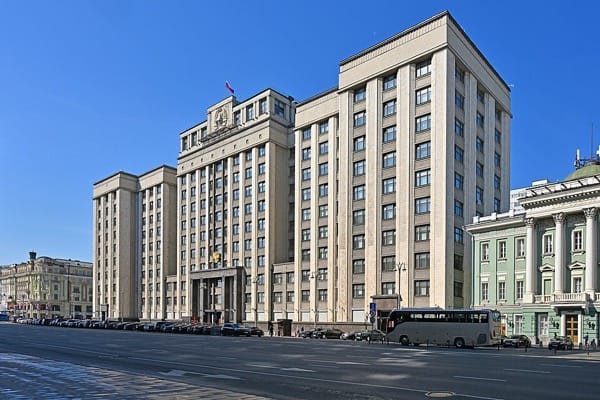
Photograph: Юрий Д.К., Wikimedia Commons, CC BY 4.0. Resized to 600 × 400 pixels.


.jpg)