

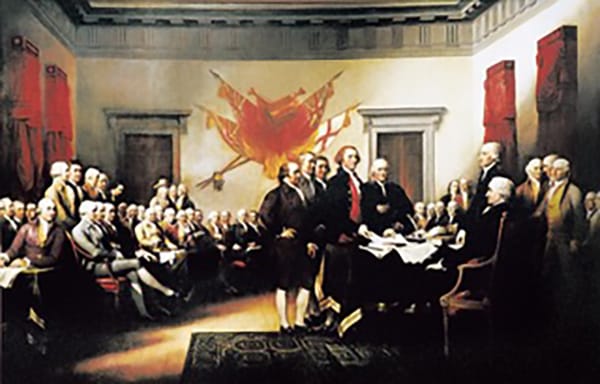
250 YEARS OF AMERICAN INDEPENDENCE.
THE CRISIS OF HEGEMONY AND THE LIBERATION OF NATIONS
American hegemony rests not only upon military bases, the dollar and NATO, but also upon the infrastructure of informational dominance: interception, codebreaking, control of communication channels, digital surveillance, cyber operations and the legal framework governing global access to data. From the breaking of Japanese codes in the twentieth century, the line extends to the NSA, U.S. Cyber Command, Section 702 of the Foreign Intelligence Surveillance Act (FISA), satellite systems, Internet backbone networks and the platform power of the twenty-first century.
If Washington’s global leadership rests upon power, debt and a system of alliances—what will happen when that structure begins to unravel?
From this standpoint, I once again note with satisfaction that we, the socialists of different continents, are confronted by the same immense obstacle that stands in the way of the free development of all nations in general and of every nation in particular—a development without which we shall neither be able to begin, nor, still less, complete the social revolution in our respective countries through cooperation with one another.
The fundamental principles of the theory that continues to unite within one common camp of struggle the overwhelming majority of working people on every continent require us to take a sober view of the nature of this obstacle. This obstacle is a new Holy Alliance: an alliance of states and institutions directed, since the middle of the twentieth century, from the Washington centre and continuing to exist to this very day despite all temporary internal disputes. It was created as the military organisation, the North Atlantic Treaty Organization (NATO), behind which stand the interests of international capital against the revolutionary movement of the peoples of all countries. In 1949 it embraced the states of Western Europe, and by 1951 it had subordinated Japan to its military and political course, transforming it into a bastion of imperialism in East Asia. Its purpose remains exactly the same today: to safeguard the domination of capital, to crush the revolutionary movement, to suppress the national liberation aspirations of peoples, and to direct the power of the imperialist states against the organised struggle of the working class.
Since the United States possesses military and financial power almost beyond the reach of direct opposition, American hegemony forms the core of this alliance—the principal reserve of world reaction. Germany, deprived after 1945 of genuine military sovereignty, obediently carries out the will of its overseas patron by hosting its arsenals upon German soil. Great Britain, once the ruler of the seas, has resigned itself to the role of an obedient “partner”, prepared to answer first to any call from Washington, however absurd. Japan and South Korea serve as advanced bastions against the “disobedient neighbours” of the Far East. Poland and the Baltic states have become literally occupied by American military and economic dictatorship, while every form of national freedom in Eastern Europe has been suppressed through the British model of governance—that is, the old special system for governing nations. Just as Britain once governed nations, the United States today employs the same model of rule. This alliance has been consolidated through the annexation of territories and, above all, through the annexation of national sovereignty—by means of debt obligations, military bases, and the imposition of political regimes obedient to the interests of the United States of America.
In order to make it easier, from the standpoint of bureaucracy, to deal with dozens of nations and national minorities in Eastern Europe, American imperialism selected several states—Poland, Romania, Hungary, the Baltic states and Ukraine—and granted them a “privileged” status: advanced military bases, priority financing, and the role of “front-line states”. On what grounds? On the grounds that it is more convenient to deal with two or three nations and the governments that lead them than with half a hundred nations and minorities stretching from the Balkans to the Baltic. Within this very region there exist numerous peoples and national minorities: Russians in the Baltic states, Hungarians in Romania and Slovakia, Poles in Ukraine, Ukrainians in Poland, the Roma population of the Balkans; and, according to this logic, Washington finds it more economical to single out several nations, grant them privileges, and govern all the others through them, because, firstly, the resentment of the remaining nations will in that case be directed against those privileged nations within these states rather than against the United States itself—which is the principal consideration—and secondly, because it is cheaper to busy itself with two or three “partners” than to administer an entire region directly. But if one abstracts from these bureaucratic conveniences, then this system contains the certain death of American domination in Eastern Europe; within this very system lies its inevitable death, as surely as two and two make four—the death of American administration and American rule.
For by privileging some nations while oppressing others, Washington creates not loyalty but hatred; it raises not allies but enemies; it lays a mine beneath its own domination. And when that mine explodes, the entire structure of privileges will collapse with it. To overthrow American imperialism in the form of the dollar and military bases, to destroy this nightmare weighing upon the whole of Europe and the entire world—this, in my view, is the first condition for the liberation of the nationalities of Central, Southern and Eastern Europe. For so long as this centre of world imperialism exists, no social revolution can either be begun or, still less, completed through the cooperation of the working people of different countries. Once American hegemony is crushed, all the satellite regimes sustained solely by its bayonets and dollars will fall after it. Once American imperialism is crushed, it will be followed by the downfall of the ill-fated pseudo-autocratic Russia currently represented by Putin and his police-oligarchic clique.
Indeed, the logic of this domination is internally contradictory. It rests upon three pillars: firstly, upon control of the world financial system, in which the dollar serves as an instrument of coercion; secondly, upon a network of hundreds of military bases encircling the globe; and thirdly, upon ideological hegemony, imposing at one moment right-wing radical standards and at another short-lived liberal standards full of illusion as though they were the only possible course. Yet each of these pillars is being undermined from within: the overheating of the economy, colossal social inequality within the United States itself, growing resistance in the colonies, and the emergence of new economic centres challenging the monopoly of the dollar—all this renders the American system increasingly fragile. For an empire that can no longer provide material prosperity for its subjects and is compelled ever more frequently to resort to direct violence is an empire condemned. As soon as this system begins to falter, its military architecture in East Asia, having lost the sole purpose of its existence, will collapse with it; the countries of Latin America, for decades regarded as the “backyard” of their northern neighbour, will at last be able to dispose freely of their own natural resources and determine their own economic policy; the states of the Middle East will free themselves from the policy of imposed “protection”; and finally, the great American people themselves will strive no longer after imperial fantasies pursued for the benefit of three managing corporations and two or three dozen billionaire families, but will fulfil their genuine civilising mission, developing their immense intellectual powers in cooperation with the West instead of shedding the blood of their finest sons in imperialist wars. Having freed themselves from the burden of endless wars, they will direct their energies not towards maintaining an empire but towards meeting their own social needs.
NATO will dissolve as a military-political bloc—that is, the artificial alliance of states sustained above all by American military, financial and political hegemony—and will lose the sole purpose of its existence: to serve as an instrument for preserving the imperialist order and preventing the independent development of the peoples of the world. As for the former republics of the USSR, they too will become independent not merely in words but in reality. At present, however, their “sovereignty” remains in many respects little more than a formality, while their domestic and foreign policy, together with their economic and commercial life, remains subordinated to a system of external dependence. Once the world domination of American imperialism has been broken, the entire system of political and financial subordination created by it will collapse as well. Then the peoples of the Caucasus, Central Asia, Moldova and Belarus will be able to determine their own destiny, for together with the collapse of the imperialist centre the entire system of dependence erected by it will inevitably disintegrate.
At the present moment this alliance appears to have entered a period of decay; the threat of a great war has once again drawn dangerously close. But if such a war does break out, it will do so solely for the purpose of preserving the world domination of American capital, placing the principal burden of war upon Europe and transforming it into the principal theatre of military operations. I hope that peace will be preserved; in such a war one could sympathise with none of the belligerent sides—on the contrary, one could only wish that all of them should be defeated, if such a thing were at all possible. Such a war would be terrible, yet whatever its outcome, it would ultimately serve the cause of the socialist movement and hasten the victory of the working class.
Thus, in summing up our analysis, it must be said that American hegemony constitutes today the principal obstacle to the free development of nations and one of the foremost strongholds and bastions of the world domination of capital. Yet no empire is capable of arresting the course of historical development, for imperialism merely deepens contradictions, accelerates the maturation of the revolutionary crisis, and thereby prepares the conditions for its own downfall. It follows, therefore, that the struggle against American hegemony is not a preliminary condition of the social revolution, but one of its most essential constituent parts.
UNDERSTAND THE MECHANISM.
NOT JUST THE NEWS — REVEALED IN OUR BOOK.
“THE POWER OF SELF-SEEKERS & GRABBERS” → BUY NOW
“Not a book about Putin. A book about the machine that keeps him in power.”
Release Date: July 4, 2026
Author: Alex Zarin
Editorial Board “The Eastern Post”
Publisher: The Eastern Post, London-Paris, United Kingdom-France, 2026.
Read other analytical materials on easternpost.uk and subscribe to our updates.