

By Felix Alglave
France, October 2026. Class Contradictions and the Struggle for State Power
The French bourgeoisie demands order. Its ministers demand order. Its newspapers demand order. Its political stewards vie with one another in swearing to restore order. Splendid, gentlemen! But allow us to ask: order for whom? For the worker forced to count the pennies until the next payday? For the pensioner robbed of two years of well-earned rest? For the small shopkeeper afraid of ruin? Or for the capitalist who needs cheap labour-power, uninterrupted production and a state that safeguards his property?
In France in October 2026, they are arguing about Sébastien Lecornu’s government, Emmanuel Macron’s political future and the presidential election of 2027. They discuss the budget, migration, security and parliamentary manoeuvres. But behind these disputes lies the principal contradiction: social production is in the hands of millions of working people, while the principal means of production and the proceeds of their exploitation remain at the disposal of capital. Ministers, party labels and parliamentary majorities change, but the capitalist remains the owner of the enterprise, and the worker remains the seller of his labour-power. And this is what we are invited to call political renewal!
When working people demand higher wages, they are told: there is no money. When they demand that pensions be preserved — the budget cannot bear it. When they seek funding for hospitals and public services — economies must be made. But as soon as the question arises of protecting property, supporting large enterprises or expanding police powers, the machinery of the state displays astonishing resolve.
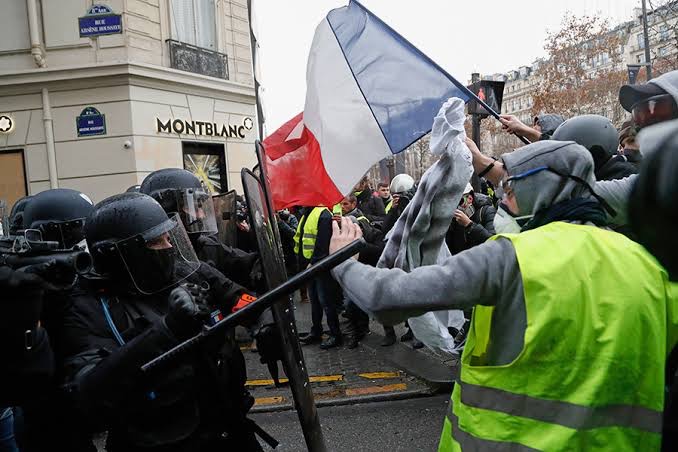
And so a convenient culprit for society’s misfortunes appears — the ‘ultra-left rioter’.
A shop window smashed? The left is to blame. A car set alight? Revolutionaries are to blame. Clashes with the police? State power must therefore be strengthened. What magnificent logic! It turns out that the cause of popular indignation lies not in the social relations that generate discontent, but in the very fact of indignation.
But a smashed shop window is not a political programme. Setting fire to a car says nothing about the class consciousness of the person who did it. Among those taking part in riots there may be people acting spontaneously, representatives of various political tendencies, criminal elements and provocateurs. A criminal does not become a communist because a bourgeois journalist has called him ultra-left.
Conflating spontaneous riots with the conscious struggle of the working class serves a quite definite political purpose. The organised left is forced to answer for the actions of people whose political affiliation is unknown. Social discontent is associated with the image of a destroyer. The demand to change social relations is depicted as a threat to security.
And who benefits? Whoever has an interest in preserving the existing order of property ownership.
Right-wing parties do not have to organise riots in order to profit from them. It is enough to use their consequences to unite different social strata under the slogan of restoring order. The worker fears violence, the small shopkeeper fears the ruin of his shop, and the capitalist fears disruption to the conditions for the accumulation of profit. While cars burn in the streets, their interests appear to coincide. But the need to stop riots does not yet mean agreement on what the social order should be once they have stopped.
Here the big bourgeois press comes to the aid of the political stewards. Vincent Bolloré, who wields considerable influence in the French media sector, helps shape the public agenda through news businesses linked to his business empire, including CNews. Naturally, the gentlemen who own them are fond of talking about freedom of the press. But this freedom does not abolish the fact that television channels, publishing houses and other means of disseminating information belong to particular owners.
Instead of wages, they discuss migration. Instead of pension rights — police measures. Instead of the causes of social discontent — the political reliability of protesters. The worker is made to fear the consequences of the crisis so that he stops asking about its causes.
Thus social fear is turned into political capital.
Now look at the gentlemen of National Rally.
Jordan Bardella is presented as the new face of French politics. Young, smooth and self-assured, he is supposed to embody the renewal of Marine Le Pen’s party. But what exactly has been renewed? Has ownership of factories and banks changed? Have capitalists renounced the appropriation of surplus-value? Have workers gained power over production? Nothing of the kind.
Bardella owes his rise to an already existing party apparatus. His political biography is bound up with Le Pen’s entourage, including Frédéric Chatillon — a longstanding associate of her political circle. At twenty, Bardella began dating Chatillon’s daughter, and later Marine Le Pen’s niece. Talk of a ‘fresh wind’ in French politics thus takes on a peculiar meaning: this wind blows straight from the Le Pen clan’s family drawing room.
But family connections are only the outward aspect of the matter. Far more significant is the political division of labour within National Rally.
Marine Le Pen addresses workers, pensioners and socially discontented sections of the population. Here, promises to protect purchasing power, intervene through the state and restore lost prosperity are brought into play. Bardella, meanwhile, seeks to convince business circles that his party poses no threat to the foundations of the capitalist economy.
Bernard Arnault, the owner of LVMH, and Patrick Pouyanné, the head of TotalEnergies, are mentioned in connection with these contacts. The economic expectations of big capital are well known: favourable taxation, cost containment, predictable regulation and the preservation of the owner’s power over the enterprise. But how can these interests be reconciled with promises of social protection addressed to working people?
Very simply — while the party is in opposition, it can promise everything to everyone.
One is tasked with gathering the votes of the discontented, the other with reassuring the owners of capital. The worker is told: we will protect you from injustice. The capitalist: we have no intention of abolishing your property. And both promises coexist perfectly well until the question of distributing social wealth arises.
The worker is sold the hope of change; the capitalist is sold guarantees against that change. And both deals are concluded in the name of the same party.
To service such an arrangement, party functionaries alone are not enough. Money, mass media, political intermediaries and connections with business circles are needed.
Here Pierre-Édouard Stérin appears — an entrepreneur who finances conservative organisations and political initiatives. Through the Périclès project, up to €150 million was to be directed towards promoting right-wing ideas. Initiatives surrounding the conservative publication Valeurs actuelles were also associated with his name. Stérin’s former adviser François Durvye found his way into Bardella’s entourage.
Combined with Bolloré’s media influence, such connections reveal the material side of political struggle. A bourgeois party does not exist in a vacuum. It needs financial resources, media support and access to the owners of capital. Above all, however, it needs to convince society that the interests of the bourgeoisie coincide with those of the entire nation.
This is where political deception begins.
The nation consists of classes with opposing economic interests. The worker has an interest in increasing his wages and improving his working conditions. The capitalist seeks to preserve the profitability of the enterprise and his power over production. Nationalist phraseology does not abolish this opposition; it merely conceals it.
It would therefore be ridiculous to portray Bardella as a young rebel who has risen against the old political system. What stands before us is not a destroyer of the power of capital, but a contender for the management of a state that safeguards that power.
National Rally likes to speak of national independence. But the history of its financing reveals a peculiar relationship between nationalist politics and international capital.
In 2014, the party resorted to Russian lending. After 2022, these connections became a politically burdensome legacy. French banks had previously refused to lend to the party, and its leaders sought funds abroad.
And then the United Arab Emirates appears on the horizon.
According to Brussels Watch, around €55 million may have entered National Rally’s political ecosystem in 2025 through structures linked to the UAE. The purported support was explained in terms of combating political Islamism. However, this account raises the question of the possible acquisition by foreign capital of political influence within European institutions.
Thierry Mariani, Alexander Babakov and Konstantin Malofeev are among the figures named in connection with the alleged intermediary relationships. Mariani is a politician who spent years exchanging kisses with Russia’s pseudo-autocracy and is now courting Abu Dhabi’s political circles with the same zeal.
What an instructive spectacle! At rallies — speeches about national independence. In international politics — a search for allies among the holders of capital.
The alleged mechanism consists of using the UAE’s financial infrastructure and intermediaries to preserve political influence under sanctions restrictions. Within this account, a hypothesis of possible coordination between Russian and Emirati structures has also been advanced. The political significance of this account is clear: a change in the geography of money flows can make it harder to establish the real interests behind the financing.
But a Marxist has no reason to be surprised by the international connections of bourgeois politicians.
Capital is international in its movement, although its representatives readily shelter behind national flags. Finance capital seeks profit, markets, influence and guarantees of property. Patriotic phraseology is useful to it insofar as it helps secure these interests.
Nor is the big French bourgeoisie obliged to tie its political future to a single president. While Macron and the traditional right fight to retain their influence, business circles may seek additional channels through which to represent their interests.
Here Bardella proves a convenient figure. Behind him there already stands a party organisation with a mass electoral base created by Marine Le Pen. He can offer capital political influence without relinquishing the support of voters dissatisfied with the consequences of capitalist policies.
But the opposition between class interests cannot be abolished by allocating party duties. Once the party gains state power, its promises will have to be tested against the budget, taxation, pension policy and labour legislation.
Then the real content of the political deal will be revealed.
Macron’s liberal critics see the cause of society’s misfortunes in the president’s mistakes. The right accuses the government of weakness. Reformists demand a new parliamentary majority. But all these gentlemen evade the fundamental question: which class does state power serve?
The bourgeois state does not cease to be bourgeois because one minister replaces another. Its class character is determined not by the president’s surname, but by the social relations it safeguards. Capitalist property remains, wage labour remains, the appropriation of surplus-value remains. Consequently, the economic foundation of bourgeois domination remains as well.
Article 49.3 of the French Constitution demonstrates the powers of the executive particularly clearly. Under Élisabeth Borne’s government, this mechanism was used more than twenty times, allowing bills to be passed without an ordinary vote on their substance unless parliament passed a motion of no confidence.
Naturally, everything took place within constitutional procedures. But did this make the class significance of the decisions disappear?
Recall the pension reform of 2023. Millions of French working people opposed raising the retirement age to 64. The government used Article 49.3 to push through the reform. Working people were told of the need for the pension system’s financial sustainability. The result was an increase in the statutory retirement age.
There you have the bourgeois state machine in action!
However, it would be a mistake to portray the state as a mere secretariat for individual capitalists. Contradictions exist between the industrial, commercial and financial bourgeoisie. Different groups of capital compete for state contracts, subsidies, tax advantages, access to credit and influence over economic policy.
But when the question of preserving capitalist property relations arises, their common class interest reveals itself. This is the foundation of the ‘party of order’.
Its participants may quarrel bitterly over ministerial posts and accuse one another of incompetence and betrayal of national interests. But all of them have an interest in preserving a social system in which capital dominates labour.
The class content of state policy becomes particularly clear in the distribution of social costs. When the government announces the need for budgetary austerity, the question concerns more than the amount of expenditure being cut. The crucial question is: at whose expense are the savings made?
If social benefits are restricted, spending on public services is cut or pension obligations are changed, these decisions must be compared with the taxation of capital, subsidies to enterprises and expenditure on servicing public debt. It is the distribution of material costs, not the solemn declarations of ministers, that shows whose interests take precedence.
Here another contradiction of the bourgeois order reveals itself.
Capital needs a strong state capable of protecting property and ensuring the conditions for the accumulation of profit. But individual groups of the bourgeoisie also have an interest in direct control over state decisions. By strengthening executive power to defend the overall order, they may restrict their own political influence.
The state apparatus acquires relative autonomy from individual parties and business groups without ceasing to safeguard existing property relations.
Yesterday, the political defenders of order demanded an expansion of state powers against their opponents. Today, they discover that the apparatus they strengthened is capable of taking decisions without their consent.
Order begins to devour its own political defenders while continuing to safeguard the economic domination of the bourgeoisie.
This is precisely why the political removal of individual representatives of the ruling class does not yet mean the abolition of its power. Capital can replace its political stewards while preserving the property relations for whose defence the state machine exists.
Popular indignation is not born at the moment when the first crowd appears in the square. It accumulates in everyday life, in the constant clash between human needs and the conditions of existence.
The worker sees wages falling behind expenses. The pensioner is forced to economise on necessities. The small entrepreneur faces rising costs and declining purchasing power among the population. But initially, each perceives his situation as an individual misfortune.
Bourgeois ideology readily sustains this notion. People are told that their poverty is the result of personal failure: they did not work hard enough, managed their money badly or failed to adapt to circumstances.
Thus a social contradiction is turned into an individual sense of guilt.
However, identical conditions of existence gradually reveal the common situation of different people. The worker notices that his fellow workers at the enterprise face the same difficulties. An individual complaint acquires a social character. Here lies the source of spontaneous indignation.
But a spontaneous movement is not yet a conscious political struggle.
The French proletariat is not an abstract mass from a textbook of political economy. It consists of industrial workers, railway workers, transport workers, dockers in Marseille and Le Havre, and workers in the energy sector, hospitals, municipal services and logistics centres. Their labour sustains the country’s everyday life. Without railway workers, trains do not move; without dockers, ships are not unloaded; without energy workers, production stops.
But who owns the enterprises where they work? Who decides how many people to dismiss, where to direct profits and which production facilities to close? Who controls the results of social labour?
This is where the real line of class division runs.
At the same time, a worker, a small shopkeeper and a student may oppose the same government while being guided by different material interests. As long as immediate discontent unites them, the differences remain in the background. But when the question of the future organisation of society arises, the contradictions may emerge with renewed force.
A small proprietor may support a protest against taxation while simultaneously demanding stronger police action against strikers. A worker may advocate an increase in his own wages but condemn a strike by other workers if he is convinced that it threatens his well-being.
Consequently, shared discontent does not yet mean shared class consciousness.
Spontaneity reveals a social contradiction, but does not in itself determine the direction of its resolution. Mass action can shake the established order and then bring to power political forces promising to restore that order on harsher terms.
This is why the heroism of individual participants is no substitute for organisation, and the intensity of a confrontation does not yet prove that the tactics are correct. Political maturity requires distinguishing the moment when decisive action broadens support for the movement from the moment when it makes the opponent’s task of isolating it easier.
Without conscious class organisation, spontaneous indignation risks becoming a political resource for the very forces against which it was originally directed.
The bourgeois state has more than the police, courts and administrative apparatus at its disposal. It can exploit contradictions within the working people’s movement itself.
The first method is to pit moderates against radicals. Some are offered negotiations and partial concessions; others are declared irreconcilable extremists. Common demands break up into separate agreements, and the most active participants find themselves isolated. But political solidarity does not require justifying every action committed under the banner of protest. It requires distinguishing real disagreements, criminal acts by individuals and attempts to use these circumstances to destroy the organisation.
The second method is to set working people against one another economically. Workers are told that pensioners cost the state too much. Pensioners are told that wage increases threaten the budget. Healthcare expenditure is set against education, and the social guarantees of wage workers against the interests of small entrepreneurs. Thus the struggle over the distribution of social wealth is turned into a clash between those who receive only a limited share of that wealth. Yet without an analysis of taxes on capital, state subsidies and every area of budgetary expenditure, such oppositions serve above all to conceal the actual distribution of social costs.
The third method is to exploit the fear of disorder. Society is offered a choice between the existing order and chaos, as though no other social relations were possible. Protection from violence is gradually equated with the necessity of unconditional submission to the state apparatus. As a result, even people who initially opposed the government may support the expansion of its powers.
The fourth method is to turn the state into an imaginary arbiter standing above classes. When social groups are exhausted by mutual contradictions, the government portrays itself as the only force capable of reconciling their interests. Workers are promised social guarantees, entrepreneurs protection of property, and pensioners stability of payments. But the promises themselves do not eliminate the opposition between labour and capital. The state appears to stand above society, although its decisions continue to determine the distribution of social resources and the conditions of existence of different classes.
These mechanisms cannot be countered by calls for unity alone. Clear demands, accountable representatives, openness in negotiations and the ability of participants to assess proposed agreements independently are necessary.
A partial concession can strengthen the movement if it improves the position of working people and preserves the possibilities for further struggle. But a concession bought at the cost of destroying the organisation and abandoning independent aims can become an instrument of defeat.
Unity without a class programme is fragile. Discipline without political consciousness is blind. And a movement without independent leadership becomes the prey of others’ political interests.
Here the central question emerges — the one bourgeois politicians and their opportunist fellow travellers prefer to evade.
Workers may strike, students may demonstrate, and pensioners may demand the protection of their rights. But who will unite these demands into an independent political programme of the proletariat? Who will explain the connection between wages, the state budget, profit and property? Who will confront bourgeois parties not with yet another popular politician, but with the organised force of the working class?
Without answers to these questions, talk of struggle remains half-hearted.
The working class needs a revolutionary political party. Not an electoral office trading in promises before the next election. Not an appendage of a liberal or nationalist party. Not an association of political careerists sheltering behind the name of the proletariat. What is needed is a party with a definite programme, ideological independence, discipline and accountability to the class whose interests it represents.
But a party does not arise from a single resounding slogan. Its political strength is determined by its connection with the actual workers’ movement, its ability to unite disparate demands and to test its decisions in practice.
French trade unions, including the CGT, have experience of strike action and mass mobilisation. But economic struggle in itself does not yet mean the political emancipation of the proletariat. One can secure a wage increase and remain a capitalist’s wage worker. One can defend social guarantees and preserve the old property relations. One can bring about the resignation of a government and discover that the new cabinet pursues policies within the same capitalist system.
This is precisely why a class party must not confine itself to demands for individual economic concessions. Its programme must link the everyday struggle of working people to the question of power over production and social ownership of the principal means of production.
Here the question of opportunism cannot be evaded.
The opportunist promises the worker a better life but refuses to raise the question of the power of capital. He acknowledges class struggle in words but demands that it cease whenever it touches the foundations of bourgeois property. He is prepared to fight an individual minister, but not the system of exploitation. He readily speaks of social justice until the discussion turns to who owns the factories, banks and enterprises.
Thus revolutionary terminology becomes a cover for a policy of accommodation to capitalism.
But the revolutionary organisation itself must not become the property of its leaders either. Political discipline has meaning only when combined with clarity of programme, accountability to the participants in the movement and the ability to monitor the implementation of decisions taken.
Otherwise, the struggle against others’ political domination risks ending in the reproduction of dependence within the organisation itself.
Not everyone who opposes the government opposes the domination of the bourgeoisie. And not everyone who calls himself a revolutionary expresses the independent interests of the working class.
The French workers’ movement faces more than the abstract question of whether the next president is good or bad. It faces questions of organisation, political programme and tactics.
The struggle over wages must expose the relations between labour and capital. The struggle over pensions — the class content of budgetary policy. The struggle against dismissals — the owner’s power over production and the fate of workers. The defence of public services — the question of the distribution of social wealth.
Trade union struggle requires independence from bourgeois parties. Negotiations and agreements must be assessed by their actual consequences for the position and organisation of working people, and representatives of the movement must be accountable to those whose interests they express.
The question of participation in elections, political alliances and forms of strike action cannot be resolved by a single abstract slogan. Tactics depend on the balance of forces, the state of organisations and the movement’s specific aims. But neither elections, nor agreements, nor individual concessions must replace an independent class programme.
A political organisation must distinguish resolve from adventurism. A continuous offensive does not always mean a strengthening of positions. Sometimes outward boldness conceals exhaustion and a loss of public support. Preparation, a change of tactics and a temporary retreat can preserve the possibilities for further struggle.
At the same time, class independence does not mean rejecting all agreements. It means the ability to assess them from the standpoint of working people’s interests without turning temporary allies into the movement’s political masters.
But one principle remains unchanged: the interests of the proletariat must not be subordinated to the struggle of bourgeois groupings for state office.
A workers’ movement that abandons its own programme risks becoming the political reserve of another party. Today its votes are needed by liberals, tomorrow by nationalists, and the day after tomorrow by yet another saviour of the fatherland.
The working class is under no obligation to serve as the electoral infantry of the bourgeoisie.
So what are the defenders of order seeking?
Macron proposes to preserve the stability of existing state institutions. Le Pen and Bardella promise to renew the political leadership and change the direction of particular state decisions. But none of these programmes envisages the abolition of capitalist ownership of the principal means of production.
There lies the limit of their political confrontation.
They argue over who will govern the state, but do not raise the question of abolishing the economic power of capital. They offer different ways of managing bourgeois society, but not the emancipation of wage labour from capitalist exploitation.
A political party should therefore be judged not by the loudness of its speeches or the popularity of its leaders, but by the class content of its programme. Who owns the means of production? Who controls the results of social labour? In whose interests are state funds distributed? What property relations does political power defend?
These are the questions before which parliamentary manoeuvres and election promises pale.
It is not enough to replace Macron with Bardella, dismiss Lecornu or elect a new parliamentary majority. As long as the capitalist controls the means of production, the worker is compelled to sell his labour-power. As long as production is subordinated to the extraction of profit, the economic foundation of exploitation remains. As long as state power safeguards these relations, a change of political leadership does not abolish the domination of the bourgeoisie.
But indignation against the existing order alone is not enough either. Without class consciousness, independent organisation and a revolutionary party, spontaneous discontent can become the prey of capital’s political stewards again and again.
Today one steward promises stability. Tomorrow another promises national revival. The day after tomorrow a third promises social justice. Behind them stands the same master.
Capital.
This is the contradiction of the French ‘party of order’. Bourgeois groupings struggle for the right to control the state apparatus, strengthen it to protect property, and then themselves become dependent on the mechanism they have created. Order devours its own political defenders while continuing to safeguard the economic domination of the class they serve.
But for the proletariat, the question is different. It is not enough for it to replace the manager of the capitalist economy. Its historical task is to overcome the very property relations under which social production is subordinated to private appropriation.
Not a change of bourgeois stewards, but the emancipation of labour from the power of capital. Not another parliamentary manoeuvre, but the independent political organisation of the working class. Not promises of a new order, but a change in the social relations on which the old one rests.