

PetroSaudi Scandal: Financial Capital and Financial Oligarchy
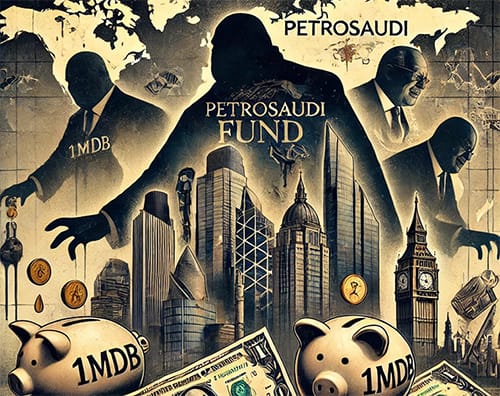
The scandal involving the embezzlement of $1.8 billion from the Malaysian state fund 1MDB which culminated in the conviction of PetroSaudi executives, vividly illustrates the corrupt nature of the capitalist system, where the financial elite exploits state resources for personal gain. Tarek Obaid and Patrick Mahony, found guilty in this global scheme, received seven and six years in prison respectively, and lost assets worth over $240 million. However, their conviction is just the tip of the iceberg, concealing the close ties between the City of London, the British and Saudi royal families, and the world’s largest financial circles.
The City of London financial center played a key role in laundering money from 1MDB through complex investment schemes developed with the involvement of banks and fund managers such as Morgan Stanley and other major financial players. Among the significant figures whose names emerged in the context of the case were financial magnates like Tim Hayman (former head of Cazenove) and Peter Mandelson, known for their connections to financial circles and their promotion of capital interests in politics. They not only facilitated the creation of the infrastructure for money laundering but also ensured the protection of such schemes through their connections and influence.
Goldman Sachs was also a major participant in the 1MDB scandal. They played a role in the issuance of bonds for 1MDB. Goldman Sachs issued bonds for 1MDB in three stages in 2012 and 2013:
1. May 2012: Bond issuance worth $1.75 billion.
2. October 2012: Second bond issuance worth $1.75 billion.
3. March 2013: Third bond issuance worth $3 billion.
These bond issuances were part of a scheme that later became the basis for one of the largest financial scandals in history.
Although the direct involvement of the British royal family in this scandal has not been established, its indirect connection through the City of London and close relations with the Saudi elites calls their neutrality into question. For decades, the British aristocracy and financial elite have used their influence to advance the global interests of capital, including through manipulations with funds like 1MDB.
Equally important is the connection between the Saudi royal family and the Rockefeller family, shedding light on the close intertwining of financial and political interests. Saudi capital, a significant portion of which is managed by Morgan Stanley, is closely linked with global elites, including the Rockefellers, who have historically influenced the energy market and the global financial system. These connections underscore that Saudi capital, like the capital of other monarchies, is not independent but is part of a global exploitation network where the main beneficiaries are in the City of London and New York.
In the context of the 1MDB case, key figures, besides Tarek Obaid and Patrick Mahony, include Jho Low, known for his connections with global elites and his role in organizing the thefts. It is also important to note the role of fund managers, including Morgan Stanley, who provided the platform for the implementation of financial manipulations. These names are not just participants in criminal schemes but represent global capital that uses its influence to undermine state systems and enrich itself at the expense of public wealth.
China and 1MDB
One of the key aspects of 1MDB’s activities was its close ties with Chinese state corporations, such as the China Railway Engineering Corporation (CREC), which in 2014 entered into a large-scale partnership with the fund for the Bandar Malaysia project. This project, worth over $7 billion, involved the development of a vast area in Kuala Lumpur for the construction of a transportation hub and new urban infrastructure. As part of this 2016 deal, Malaysia offered China lucrative stakes in railway and pipeline projects for Beijing’s Belt and Road infrastructure initiative.
In 2018, the scandal surrounding 1MDB led to the removal of Najib Razak from his post as prime minister and the return of Mahathir Mohamad to that position. Since taking office, Mahathir’s government has accused Najib’s administration of inflating the cost of Chinese deals. In 2018, the new administration suspended projects worth more than $20 billion awarded to Chinese firms under Najib’s government.
Such scandals are a consequence of the capitalist system, in which state structures serve the interests of international capital. The 1MDB case, with its connections to the City of London, the British and Saudi royal families, and financial magnates, clearly demonstrates this assertion. Entire PetroSaudi scheme and its manipulations are a vivid example of how international capitalism operates with impunity and cynicism, using connections with the highest echelons of power and elites for personal enrichment. The 1MDB fund, created to improve the lives of the Malaysian people, became merely a tool for diverting funds into the pockets of international fraudsters.
Corruption schemes involving representatives of international capital are not exceptions but the rule under the capitalist system. This illustrates the correct understanding of imperialism as the highest stage of capitalism, where financial capital dominates state interests and public welfare. In this context, the confiscation of Obaid’s and Mahony’s assets and their sentences are only a small retribution in the global fight against capitalist exploitation.
The 1MDB fund, created to improve the lives of the Malaysian people, was turned into a tool for enriching fraudsters closely linked with global elites. Their conviction is only a small part of what is needed to combat global capitalist exploitation.
The trial against the PetroSaudi executives highlights the scale and unprecedented audacity of the manipulations of the global capitalist elite, using its connections with the City of London and the world’s royal houses to carry out criminal schemes. This case is just one of many illustrating the systemic injustice of capitalism, where state resources and financial flows are controlled by a narrow circle of people with power and influence. Ultimately, the 1MDB case is not just a crime; it is a symptom of the global disease of capitalism, which operates through corruption, exploitation, and manipulation, serving the interests of a few and dooming the majority to poverty and powerlessness.
Author of the Article
Catherine Kirelina