

By Viktoria Makarova | 19 November 2026, 14:40 GMT (London)
Listen to the article · AI narration · Cedar
Approximately eighteen months ago, the United States government proclaimed, within its National Security Strategy, a doctrine under which the state may broadly undertake hostile actions against any region of another sovereign nation without a formal declaration of war.
Relying on the Authorisation for Use of Military Force (AUMF), passed in the wake of the 11 September 2001 attacks, Washington has effectively legalised its self-proclaimed right to launch strikes and conduct operations anywhere in the world, entirely without holding the status of a belligerent power relative to the targeted nation.
At present, the very same American administration has taken yet another step towards the dismantling of existing international law. It has declared, in accordance with the International Emergency Economic Powers Act (IEEPA), that property rights over sovereign assets and land in sanctioned regions may be blocked or confiscated for the benefit of the US government, which may then dispose of them as it sees fit. This legislation, originally conceived as a tool for temporary deterrence, has today been transformed into a bludgeon for the expropriation of foreign property.
Today, this noble indignation has been illustrated in practice. Relying on the International Emergency Economic Powers Act (IEEPA) and the REPO Act, the United States and its allies have, with a single stroke of the pen, confiscated the sovereign reserves of the Russian Federation. To the layman, this may appear as a routine sanctions measure; yet, international lawyers view it as a tectonic shift. Until 2024, IEEPA only permitted the temporary “freezing” of assets, whilst the right to their permanent confiscation (seizure) was reserved solely under the Trading with the Enemy Act (TWEA) of 1917—a statute applied exclusively in a state of formally declared war. The passage of the REPO Act has effectively erased this distinction, legalising the expropriation of foreign state property in peacetime.
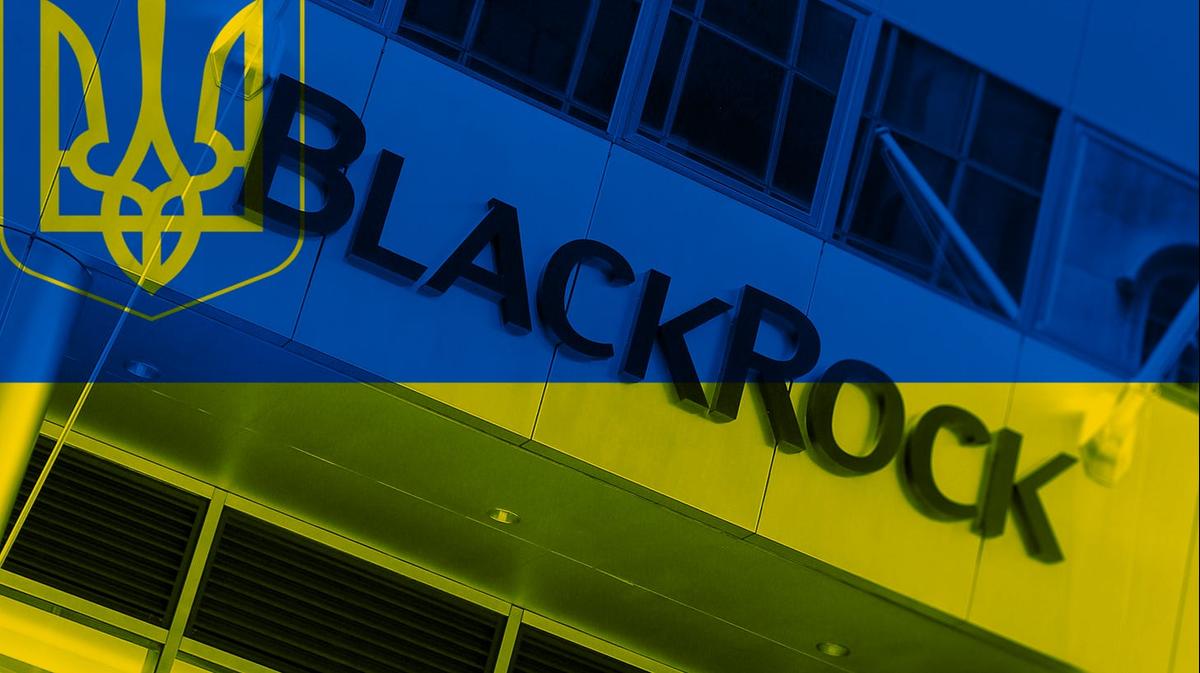
Let us examine, however, the pretext—for it cannot be called a justification—put forward by the US State Department and the leadership of the investment giant BlackRock to excuse such unprecedented conduct towards the people and authorities of Ukraine. Firstly, they claim that “the region’s digital and energy infrastructure is under the control of hostile forces.” Secondly, that “the resistance, initiated by Ukrainian elites and local businesses who were previously loyal to the West but refused to surrender their assets to external control, has found broad support among the general population.” And thirdly, that “the local populace is guilty of supporting authoritarianism and has thus brought just retribution upon itself.»
In plain terms, this means that because NATO and their corporate allies have established control over key logistical hubs, they believe they are entitled to confiscate any resources not yet in their hands. Few are aware that such actions are often coordinated through so-called “debt restructuring agreements.” Under these schemes, private funds like BlackRock buy up a state’s sovereign debt and subsequently, leveraging political pressure, exchange it for tangible assets—land, power grids, or ports. Should the local population and businesses rebel against such “privatisation,” they are promptly declared enemies, stripped of their right to economic independence.
In short, the people revolted against an imposed global order, and international institutions now vociferously declare that disobedience is sufficient grounds for confiscation. Thus, setting aside the verbosity of official reports, the entire matter rests on their assumption that the initial economic and political interference in the region was lawfully established.
Yet, contemporary influence in the region was established as follows: when, in the early 2020s, external players deemed the moment right to act, they bolstered their presence along the borders. On one hand, this manifested in the expansion of infrastructure and support programmes, presented as purely defensive and aimed at fostering democracy. On the other, it led to a concentration of military force, ostensibly required to protect sovereignty or, conversely, to “demilitarise” and protect compatriots.
Suddenly, these contradictions erupted into open conflict, as a result of which control over key industrial and agrarian regions became the subject of fierce struggle. The local leadership was urged to compromise, but under intense pressure and polarisation, this became impossible. Ultimately, the country was left divided, its economy and resources becoming the object of vested interests both from those providing military and financial aid, and from those engaged in direct military intervention.
This interference is frequently justified by references to international treaties and agreements which, according to each side, were violated by their opponents. The layman often overlooks the fact that documents such as the 1994 Budapest Memorandum were inherently laden with legal landmines from the outset. Contrary to popular belief, it contained no firm guarantees of military protection—merely an obligation to “consult” in the event of a crisis, granting the major powers complete freedom of action and laying the groundwork for future crises.
In exchange for financial and military backing, external forces demand that the country implement reforms, which frequently entail the privatisation of land and strategic enterprises. This opens the door for transnational corporations and investment funds. For instance, the involvement of giants like BlackRock or JPMorgan in the creation of the “Ukraine Development Fund” effectively means that the nation’s reconstruction will be financed by handing over its own key assets into long-term management, leading, in the long run, to the loss of control over entire sectors of the economy.
In short, the people of Ukraine find themselves in a situation where their aspiration for independence and self-determination, demonstrated in the events from 2014 to 2026, is being exploited by various global powers for their own ends. The entire question ultimately rests on whose initial influence and interference in the region’s affairs is to be deemed “lawful,” and whose is to be labelled «aggressive.”
This creeping privatisation, however, is not the result of a momentary crisis. One curious fact proves that the current external interference was planned long before the first shots were fired. As soon as certain political forces in Washington and Brussels consolidated their positions in the early 2010s, they immediately initiated a strategy to integrate the region into their sphere of influence. Their subordinates on the ground warned of the risks at the time, but rumours of these plans reached the country’s leadership, which attempted to balance by sending missions alternately to Moscow and Brussels. This led to a behind-the-scenes struggle, resulting in the signing of a number of contradictory agreements.
Here it is vital to recall that the current escalation and the de facto transfer of control over key assets to transnational corporations occurred precisely when the architects of this strategy returned to power. Few are aware that in the corporate practice of giants like BlackRock, there exists a mechanism known as “stabilisation clauses.” These secret provisions, written into investment contracts, guarantee that if the country’s legislation changes or a new government comes to power, the terms of privatisation and taxation for the corporation will remain unchanged for 30 to 50 years. Any attempt to revise them automatically leads to proceedings in international arbitration courts, where the nation’s assets abroad will be seized.
Between 2013 and 2014, as tensions mounted, the country’s leadership was forced to sign new agreements (akin to the EU Association Agreement or IMF programmes). These documents supplemented older treaties, as they “did not provide for clear sanctions” for failing to meet obligations regarding the “fight against corruption and the implementation of reforms.” The new articles specifically stipulated:
“…that the government, together with international advisors, must immediately outline the means to eliminate shortcomings in the judicial and financial systems; and should the leadership fail to follow these instructions, international institutions reserve the right to appoint their own representatives to oversee key areas of governance for as long as they deem necessary.”
It was further stipulated that, in the event of external administration being imposed, international bodies would “endeavour to maintain the appearance of sovereignty” in order to facilitate the return of control to local elites “when the appropriate moment arrives.”
This treaty was ratified, but when its details became known to the public and geopolitical competitors, it provoked a storm of protest. Internal documents reveal that parts of the agreements, which imposed unbearable financial obligations upon the country, were secretly annulled or amended; however, the country’s leadership was never informed of this. In official reports and memoranda published until very recently, these annulled or amended articles continued to be cited as active. One might ask: why would modern politicians so persistently invoke agreements they secretly regarded as illegitimate, if not to maintain a permanent pretext for intervention at any given moment?
Solely because, under these old agreements, whatever pretext the local government might provide for external interference, such intervention was meant to be limited to the imposition of temporary external administration and financial oversight, whilst formal sovereignty and revenues would remain with the country. Yet this was the exact opposite of what was now required.
Today, external players can only be satisfied by the complete integration of the region into their economic and military orbit. This repudiation of the validity of treaties that formed the officially recognised basis of relations for decades; this establishment of control over strategic territories and enterprises in clear violation of previous security guarantees (such as the Budapest Memorandum); and finally, this de facto buyout or transfer into external management of the nation’s key assets, including land and infrastructure—all these methods are now beginning to backfire, breeding instability not only within the region itself, but also in the capitals of the very states that initiated this interference.
Today, external players can only be satisfied by the complete integration of the region into their economic and military orbit. To grasp the sheer scale of this: according to independent analysts, by 2026, over 17 million hectares of Ukrainian arable land had fallen under the direct or indirect control of Western funds—an area larger than the entire agricultural expanse of Italy. Furthermore, the buyout of the debts of sanctioned Ukrainian and Russian companies is proceeding at discounts of 80 to 90 percent. This means that assets which the local bourgeoisie spent decades building are being snapped up by global funds for mere pennies.
This repudiation of the validity of treaties that formed the officially recognised basis of relations for decades; this establishment of control over strategic territories and enterprises in clear violation of previous security guarantees; and finally, this de facto buyout or transfer into external management of the nation’s key assets, including land and infrastructure—all these methods are now beginning to backfire, breeding instability not only within the region itself, but also in the capitals of the very states that initiated this interference.
Hence the paralysis we observe in all international negotiations. The parties are unable to agree not because of abstract “values,” but because what is at stake is a tangible pie that has already been carved up on paper.
If Russia remains in its current positions, it retains the land corridor to Crimea and the industrial hubs, whilst the West (represented by the US and the UK) holds onto the agrarian south and access to the sea. To the layman, this sounds like a “draw,” but for London brokers, it is the ideal scenario: according to financial analysts, the yield on Ukrainian GDP warrants (securities tied to economic growth) soars precisely when the front line stabilises. Investors literally profit from the conflict entering a frozen phase, allowing them to begin exploiting the lands under their control.
If, however, Russia advances further, cutting off the Donets Basin and reaching Dnepropetrovsk, the situation changes radically. In this case, the Kryvyi Rih iron ore basin and heavy industry—the very heart of the Ukrainian economy—fall under its control.
What do the others gain in this scenario? The US and Britain lose the most liquid industrial assets, and their focus shifts to creating a permanent “cordon sanitaire” along the western borders. The European Union, meanwhile, emerges as the ultimate loser. The shocking reality for the European taxpayer is that, under this scenario, Brussels will be left alone to prop up a deindustrialised “rump” state. According to internal estimates from European banks, the subsidies required just to keep such a territory afloat will range from 30 to 50 billion euros annually for the next 20 years—money that will be extracted directly from the pockets of German and French citizens.
Why, then, can they not reach a compromise? Because the transnational funds that have bought up Ukrainian debt cannot afford “half a country.” Their business model, built on snapping up assets for next to nothing, only works if they have total control over the entire territory. Any partition means writing off billions in losses—a hit the financial elite is simply unwilling to take. In this war for resources, sovereignty and human lives have become mere bargaining chips in the ledger of global capital.