

Protests in Georgia: The Arena of Struggle Among Great Powers
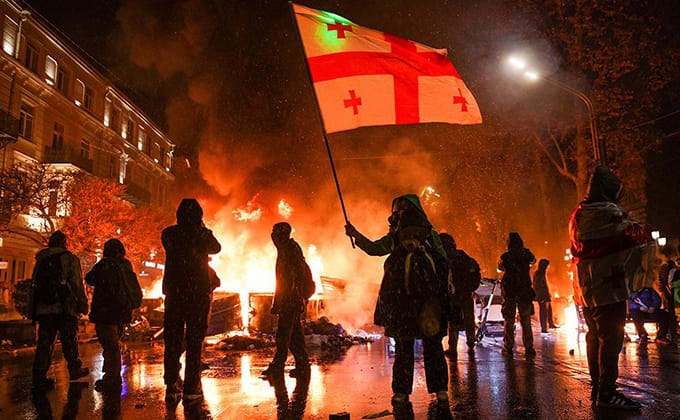
The besieged semi-autocratic Russian government is shedding its skin across all corners of the former Soviet Union. For several consecutive days, headlines in foreign and Russian media alike have been dominated by reports of “protests in Georgia.” Add to this the unrest among Russia’s reservists regarding the prospect of future mobilization, and one might think that the semi-autocratic government is losing its footing. The Georgian bourgeoisie is beginning to fracture, placing the national question on the agenda. One faction of the Georgian bourgeoisie, closely tied to the Russian government through economic interests, fears losing the privileges and power it currently enjoys and views “simple subjugation” as preferable under the present circumstances. Another faction of the Georgian bourgeoisie, in turn, closely tied to Europe and the United States, perceives such subjugation to Russia as an affront to their dignity and seeks the “liberation of Georgia from Russian influence,” aiming for control over trade routes in the global market to serve Europe’s interests. Today’s protests in Georgia represent a battle between these two bourgeois groups, the so-called Georgian elites, who are themselves representatives of dominant global powers.
Thus,
The key player in the events unfolding in Georgia is the bourgeoisie!
The primary issue for the bourgeoisie is the market!
The market is the first school where the bourgeoisie learns nationalism!
The importance of the Caucasus is determined not only by its resources—raw materials, fuel, and food—but also by its strategic position between Europe and Asia, particularly between Russia and Turkey, and its vital economic and strategic routes (Batumi–Baku, Batumi–Tabriz, Batumi–Tabriz–Erzurum). This is fully recognized by Europe, the collective West, which, having Istanbul (formerly Constantinople)—the key to the Black Sea—under its control, seeks to secure a direct route to the South Caucasus. Consider this: Georgia possesses its own port, Batumi, through which goods flow in from the West. Georgia also boasts a key railway hub, Tbilisi, which neither Armenia nor Azerbaijan can bypass, both relying on Batumi for their goods. Control over Georgia, as part of the South Caucasus region, allows one to impose ultimatums on Armenia, which cannot manage without Tbilisi, and Azerbaijan, which cannot operate without Batumi
Briefly speaking
Georgia has a privileged position in the Caucasus. Owning Georgia allows one to dictate the rules of the game to both Azerbaijan and Armenia. Whoever ultimately establishes themselves in Georgia will establish themselves in the Caucasus and will use the hub connecting Asia with Europe. Therefore, Georgia today is a platform for the confrontation of major powers such as Russia, China, Europe, and America. Global powers and transnational corporations continue to seek representatives of the bourgeoisie in the small republic who are capable of acting as connecting links in implementing their interests. Here unfolds a struggle for influence, exacerbating the so-called caste wars, in which various groups attempt to seize power and resources. Georgian elites, such as Irakli Garibashvili, Kakha Kaladze, Bidzina Ivanishvili, and others, use their privileges and power, relying on close ties with the pseudo-autocratic government. These figures, leading one of the key groups of influence, have extended a hand to the Russian government, striving to exchange loyalty for favorable conditions: cheap loans, agricultural contracts, and guarantees of safety from peasant unrest and internal dissatisfaction. To strengthen their power and spiritually pacify potential rebels, this group aligned itself with church hierarchs—bishops and archimandrites. Thus, nationalism found shelter under the wing of clericalism. This bourgeois elite zealously undertook the restoration of ruined churches—monuments of “former greatness,” which became symbols of their program. They reverently await a “miracle” capable of fulfilling their dreams of a new serfdom and monarchical order. This bourgeois caste, having experienced the hardships of free competition with foreign capital, directed all its efforts to monopolizing the Georgian market. Realizing that their weak capitalist potential cannot withstand the onslaught of foreign entrepreneurs, they chose the path of forcibly eliminating competitors. After ousting foreign bourgeoisie from the market, they artificially inflated prices for goods, justifying their actions with “patriotic” slogans. This approach led them to success in personal enrichment, turning “patriotism” into an instrument of greedy capitalism.
This is the goal of the Alliance of Nationalists, who like to present themselves as convinced patriots. However, their “patriotism” is empty if it is not backed by the real power of the working people. Only the working class, through its honest and hard labor, can breathe life into their hollow ideals. Thus, they persistently try to gain the support of Georgian workers by manipulating historical ties with the Russian people on the one hand and disparaging the socialist past on the other. With unceasing hatred for socialism, they direct their efforts at destroying the memory of the great union of the working people of Georgia and Russia, trying to tarnish it, erasing distinctions between their feudal dreams and the true interests of the working class. Using socialist rhetoric, they only strengthen their financial and monarchical aspirations. They blur distinctions and confuse the matter. An example of their actions was the introduction in 2023 of a temporary import duty on Russian flour under the pretext of supporting local producers. The Georgian government claimed that large imports of Russian flour had shut down local mills. However, the goal was to create an artificial shortage and raise prices on the domestic market. Initially introduced until November 2023, the duty was extended several times, stretching until March 2025. The tax rate was set at 0.25 lari per kilogram of wheat flour and 0.1 lari per kilogram of barley and bran. In just eight months of 2024, over 830,000 tons of wheat flour were imported into Georgia from Russia, bringing 207.5 million lari (73.5 million USD) to the treasury—vast sums used for the enrichment of the caste rather than for the people’s needs. Thus, under the guise of protecting national interests, this group of bourgeoisie continues to pursue its greedy goals, using patriotism and historical slogans as a cover for their financial schemes. The economic empire of the Ivanishvili caste, like an octopus, has spread its tentacles not only throughout Georgia but also beyond its borders, including Russia. Ivanishvili’s informal influence remains over major financial structures such as the Russian Credit Bank and Impexbank, managed through trusted individuals. Metalloinvest and other mining enterprises are connected to this oligarchic network, strengthening its position in the region’s economy. In Georgia itself, Ivanishvili’s control through Cartu Group encompasses banking and insurance sectors. Cartu Bank, a key element of his financial machinery, is used to finance loyal structures, ensuring the dependence of businesses and politicians on the oligarch’s favor. Companies involved in importing grain and flour are also under the control of this caste. Logistics enterprises like Trans Logistic Group have monopolized grain transportation through Batumi and Poti, consolidating the supply chain. AgroImport Georgia imports grain from Russia, distributing it to local milling enterprises such as Tbilisi Mill Group and Georgian Flour Mills. Through Cartu Bank and other financial instruments, Ivanishvili maintains networks linking him to Russian businessmen, including Eduard Khachatryan, CEO of ООО “Ю.О.Т.”, as well as Vladimir Yevtushenkov and Alisher Usmanov. Joint projects with these figures strengthen his positions in logistics, raw material extraction, and transportation.
Pro-Western Bourgeoisie: The Struggle for Power Under Foreign Banners
The second Georgian bourgeois group is pro-European—it is financially oppressed by the first group and cut off from monetary flows. This group lobbies for Western interests in Georgia, operating through numerous NGOs, funds, and institutions funded by Western money. The restrained caste, representing Western interests, is mobilizing. To stage an elite coup, this group appeals to the “native” lower classes and begins proclaiming Georgian national identity and patriotism, disguising their agenda of reclaiming power for the West and themselves as a nationwide cause—“movement toward Europe,” “joining the European family.” They tempt Georgian workers with tales of life in Europe, even as European workers unite in the struggle for socialism and social change. The cornerstone of their program is anti-Soviet rhetoric and anti-socialist promises. Their main goal is to undermine the foundations of the workers’ movement, which naturally tends toward socialism, and instill fear in the working class by pointing to North Korea as an example, discouraging them from fighting for their interests. Their goal is clear: to destroy the foundations of the workers’ movement and turn Georgian workers into a blind force serving Western capital.
To deal with their rival, who controls power and financial flows, the pro-Western caste of Georgian bourgeoisie recruits an army of “compatriots” in the name of the “homeland.” They aim to spark a national movement in Georgia against Ivanishvili’s caste. The “lower classes” are not always indifferent to the calls of the pro-Western caste, rallying under its banner: repression from above and social insecurity affect them too, sparking discontent.
Briefly speaking
Today, Georgia represents a petty-bourgeois republic, whose weak point lies in the complete dependence of one part of the bourgeoisie on Europe and the other on Russia. The struggle we observe today in Georgia is nothing more than a fierce clash between two opposing bourgeois factions. Both groups consist of elite castes, each striving for enrichment and retention of power. However, they are nothing more than puppets, dependent on foreign patrons. One part of the bourgeoisie serves Europe, the other—Russia. In reality, American imperialism reigns in Georgia as if it were its own, viewing it as part of its Eastern European holdings. The presence of 15 U.S. biological laboratories on Georgian soil serves as direct proof of who is the true master today. These two bourgeois factions, despite their contradictions, act according to a single scheme. Their goal is simple and cynical: to seize power, take over the economy, and exploit the working people for personal enrichment. Their programs may differ in details, but they are united by a common thread: hatred for the Soviet past, discrediting the power of workers and peasants, and weakening the unity of the working class. They follow with unconditional loyalty, unquestioningly and decisively, a single main point: “discrediting the Soviet Union and compromising the power of workers and peasants,” “preventing the unification of workers, weakening their collective strength and ability to defend their rights,” and “preventing the formation of organized workers’ movements capable of influencing political and economic decisions.” The fundamental task of these groups, this so-called elite, is bureaucracy and absolutism, where the bourgeoisie reigns and rules unchallenged, keeping the worker in a state of fear and silence—“quieter than water, lower than grass.” They zealously obstruct any attempts to organize a labor movement that could oppose their arbitrariness. These bourgeois clans aim to destroy the collective strength of workers and undermine their ability to fight for their rights and protect their interests. Their behavior, these so-called “decision-makers,” is servility in its classic form, filled with shamelessness and contempt for the people.
De facto, their power is based on fear of actual and heavy capital. Their brawl is nothing more than a division of Georgia’s economic domain by companies representing the interests of monopoly capital and strong powers. Let’s be frank: these two bourgeois groups mean nothing on their own. They act solely in the interests of their foreign masters, deciding nothing independently and having no self-determined program or opinion—classic servility in its shamelessness. The bourgeoisie, like a parasite on the nation’s body, always seeks profit, betraying the ideals of freedom and independence for the sound of coins and the rustle of banknotes. When the Georgian bourgeoisie took power into its hands after the collapse of the Soviet Union, it sacrificed on the altar of capital what once belonged to the people: industrial giants, natural resources, and even the country’s destiny. Georgia, being an integral part of a unified socialist Union, while preserving its national-cultural autonomy, was an industrial-agricultural republic with a strong economic foundation born of the collective labor of the workers and peasants of the entire Union. The forefront of its economic life was heavy industry, food production, and agriculture. Elders from mountainous regions, long-livers, can confirm that in those times, numerous factories and plants operated on Georgian soil, testifying to the industrial development of the republic. Hydropower became the foundation of Georgia’s industrialization, preceding the development of heavy industry. The Inguri hydropower complex, the largest in the Caucasus, became a symbol of the people’s labor strength, as did the Jinvali and Vartsikhe hydropower complexes, which tamed the energy of turbulent rivers. These were not just technical structures—they were strongholds of a new life where electrification became the key to a socialist future. A hydropower complex is a set of hydraulic engineering structures designed to use and regulate water resources. It can perform various functions, including power generation, navigation, water level regulation, irrigation, water supply, and flood protection. Hydropower complexes are essential infrastructure elements, especially in regions needing integrated water resource management. Georgia played a leading role in the Transcaucasus’ machinery production. Metal-cutting machines, instruments, automobiles, and even airplanes were produced here. The production of radio electronics, electric motors, and drilling equipment was of Union significance. Chiatura manganese, mined in the region’s deposits, was a pride of socialist industry. Every drop of labor by Georgian workers became a brick in the building of the common cause of the peoples of the USSR.
But what did the bourgeoisie, which took power into its hands after the destruction of the Union, do?
They destroyed the industrial might created by the collective labor of generations. Factories are closed, jobs are eliminated, and once-advanced industries—machine tool building, aircraft construction, and radio electronics—fell victim to Western monopolies, which reduced them as competitors. The bourgeoisie, blinded by greed, betrayed not only its own people but also their future.Georgia, once a proud republic standing shoulder to shoulder with other fraternal nations, is today in the chains of foreign capital. Manganese mines, which once belonged to the working people, are now in the hands of British billionaire Ralph Oppenheimer and his company “Stemcor.” This firm has taken over key enterprises: the Zestafoni Ferroalloy Plant, the Chiatura Mining and Enrichment Complex, and even the strategic hydropower station “Vartsikhe 2005.” Their products are not used for the needs of the Georgian people but serve to enrich capitalists from Europe, the United States, and other countries. At such a price, the Georgian bourgeoisie traded the sovereignty and labor pride of its people for the clinking coins of Western capitalists. These “free” entrepreneurs sold the legacy created by collective labor for a pittance, turning a flourishing republic into a resource appendage of Western corporations.
Let’s look at what the so-called “independent” Georgia represents today.
It is a state governed by oligarchs for whom the interests of the people are meaningless. The economy is destroyed, social guarantees are eliminated, and ordinary people are plunged into poverty. The bourgeoisie has betrayed everything: from factories to the souls of their compatriots. Georgia’s enterprises, mines, and power plants are either ruined or under the control of transnational corporations, managed from the centers of global imperialism—London, Paris, Beijing, Moscow, and Washington.The entire Georgian economic sphere is fragmented and cartelized by various capitals, sometimes intertwined but often competing with each other. The penetration of American, Russian, European, British, and Chinese capital manifests in the creation of subsidiaries, conglomerates, cartels, cooperatives, and trusts, ultimately managed from imperial centers such as China, the USA, France, Germany, England, and Russia. In these conditions, a fierce struggle unfolds for spheres of influence in Georgia, leading to significant political upheavals. Georgia, subjected to monstrous industrial devastation, has turned into a raw-material colony for the world’s major powers. The country is now under the full control of the largest global monopolies.
The Penetration of Russian capital into Georgia
What lies behind the facade of “independent” entrepreneurship? The owners of JSC RMG Copper and RMG Gold are entangled in the intricacies of offshore schemes, making it impossible to identify the true beneficiaries. This network of companies, registered in various jurisdictions, was created not for transparency but to conceal the real owners. In 2012, it became known that Russian businessmen Dmitry Troitsky and Dmitry Korzhev, co-founders of the “O’Key” hypermarket chain, acquired the Georgian companies Madneuli and Quartzite (later renamed RMG Copper and RMG Gold) through their company Capital Group. However, other figures were also revealed within this business, including Georgian parliamentarian Koba Nakopia, whose 22% share became a subject of disputes and manipulations. Nakopia claims he sold his share back in 2013, but the deal remains unresolved, casting a shadow of uncertainty. The management of these enterprises was entrusted to representatives of Russian capital. Thus, Sergey Yeganov, a Russian citizen, became the director of RMG Gold. Yeganov had ties to the major “Saint Petersburg Bank,” where he served on the same board as Troitsky and Korzhev. Along with him, Alvydas Brusokas and Vakhtang Paresishvili also held leadership positions. Indirect evidence suggests that Capital Group is affiliated with the assets of Alfa Group (Pyotr Aven) and Interros (Vladimir Potanin). Russian capital penetrates Georgia’s economy through the establishment of Russian company subsidiaries, participation in cartel agreements, and integration into critical industries.
Establishment of Russian Company Subsidiaries
Energy Sector:
Inter RAO Georgia: Established as a subsidiary company, it deals with electricity trading. Inter RAO owns “Kramhesi 1” and “Kramhesi 2” and participates in electricity distribution through the company Telasi (owning 75% of shares). But who is behind Inter RAO? Evidence points to close connections with Russian energy magnates, including shareholders of PJSC Gazprom. The scheme is structured so that, through a chain of companies in Cyprus and Luxembourg, control is actually exercised by a group of investors affiliated with elite Russian oligarchs and international banks. In this system, German and Austrian funds, connected to members of the Oppenheimer and Thyssen families, play a key role. These funds act as nominal owners of shares in Inter RAO Georgia, creating the illusion of company independence.
Lux Energy Trading LLC: Registered as a mediator for importing electricity from Russia to Georgia, Lux Energy Trading LLC is one of the tools for manipulating the energy market in the region. At first glance, the company operates as an independent player, but its ownership structure and management reveal ties with Russian and international financial circles. Lux Energy Trading LLC is backed by offshore structures registered in Cyprus and the British Virgin Islands. These companies are directly affiliated with Russian elites, including close associates of Arkady Rotenberg, known for his role in Kremlin construction and energy projects. Additionally, traces lead to funds managed through Liechtenstein and Luxembourg, linking Lux Energy Trading LLC to groups associated with Timchenko and the Magomedov brothers (managers affiliated with former Magomedov assets are tied to Medvedev’s circle). This setup allows control over resources through nominal executives. In turn, these funds are connected to investment structures financed through Deutsche Bank and Credit Suisse, where controlling stakes are held by Rothschild family funds. Lux Energy Trading LLC operates as a key intermediary in energy transactions, ensuring the import of electricity from Russia to cover deficits in the Georgian market. However, its actual role extends beyond simple trade. The company manages electricity prices and flows in a way that creates dependence on Russian supplies. For example, in 2021, Lux Energy Trading LLC participated in an agreement to supply 1.2 billion kWh of electricity. The contract terms were set so that electricity prices exceeded market levels by 15%, raising suspicions of collusion with local regulators. Beyond Russian oligarchs, Lux Energy Trading LLC is affiliated with international groups such as Enel Green Power and Siemens Energy. These connections strengthen its position as an intermediary in major infrastructure projects financed through the European Investment Bank and the World Bank. For example, in 2022, the company acted as a mediator in a $250 million deal related to modernizing energy infrastructure in Eastern Georgia. Contracts were distributed among contractors connected to German and Austrian financial groups, including the Oppenheimer and Thyssen families. Lux Energy Trading LLC serves not only as an economic but also a political influence tool. By controlling energy flows, the company enhances Georgia’s dependence on Russian resources while acting as a link between Russian and European elites, ensuring coordination of their actions in the Caucasian market. Such ownership and interaction structures indicate that Lux Energy Trading LLC is not just a business but part of a major strategy for financial and geopolitical control of the region. Its activities enable global players to manipulate Georgia’s energy market, leveraging its strategic position.
Banking Sector:
VTB Bank Georgia: A subsidiary of VTB, serving both private and corporate clients. VTB Bank Georgia, a subsidiary of Russian VTB, represents one of the key tools for controlling financial flows in Georgia. Through complex schemes and links with Russian state structures, the bank provides services not only to private and corporate clients but also for strategic projects. However, behind the facade of regular financial activity lie connections to influential groups and the interests of financial-industrial barons. The key role in managing VTB belongs to Andrey Kostin, who not only heads the group but is also considered one of the Kremlin’s trusted figures. Under Kostin’s leadership, VTB has become a powerful financial lever used to implement Russian geopolitical goals. In Georgia, the bank acts as a linking mechanism, managing capital flows through the region. The real beneficiaries, however, are more complex. Behind the offshore structures that formally own shares in VTB Georgia are European financial funds linked to German corporations Siemens and Thyssen. These corporations, historically mediators in financing large international projects, use their positions to access financial resources and data. Through its Georgian subsidiary, VTB actively participates in financing infrastructure and energy projects. For example, the bank was involved in lending for hydropower plant construction in Western Georgia. Funds allocated for these projects passed through a chain of offshore accounts, concealing the true sources and ultimate goals of investments. One example is the $150 million modernization project for energy infrastructure, where VTB acted as an intermediary. A specific case is the completion of the Hobi 2 hydropower plant in Chkhorotsku municipality in 2024 with a budget of $63 million. This and other projects, like the development of the Heledule-Lajanuri-Oni power transmission network, received $45 million in funding. Investigations revealed that a significant portion of these funds was spent on purchasing equipment from companies such as Siemens AG, Alstom, General Electric (GE), ABB (Asea Brown Boveri), and Voith Hydro, associated with the Rothschild and Oppenheimer families. Thus, the bank serves not only as a financial institution but also as a mechanism for redistributing capital among international elites.
Alfa Group: Alfa Group holds shares in various companies, including ABH Holdings SA, which invests in banking groups across the CIS and Europe. As such, access to Alfa Bank services in Georgia is facilitated through partner banks and financial institutions connected to Alfa Group on an international level. Alfa Group, led by Mikhail Fridman and Pyotr Aven, occupies a key position in international financial influence networks. This group, with assets in the CIS, Europe, and the United States, actively utilizes its resources to penetrate strategically significant sectors, particularly in Georgia. Behind the facade of a private structure lie the interests of global elites, such as the Rockefellers and Rothschilds, operating through complex networks of funds, companies, and offshore entities. Fridman, with a longstanding history of collaboration with international financial structures, employs institutions like BlackRock and Vanguard to promote Alfa Group’s interests. The managing entity, ABH Holdings SA, registered in Luxembourg, serves as a key instrument for the group. It directs investment flows, distributing them through banking and investment channels in the region. This structure is actively engaged in financing Georgian infrastructure, energy, and telecommunications. Financing projects in Georgia, amounting to over $500 million, passed through chains of associated banks and funds. Among these projects is the modernization of energy infrastructure, with significant portions of equipment supplied by companies like General Electric and ABB, affiliated with JP Morgan Chase and Rothschild & Co. The financing mechanism involves loans through banks controlled by Alfa Group, such as VTB Bank Georgia, and offshore structures, which allow the avoidance of direct oversight and audits.
Energy Sector Projects in Georgia:
Another example of Alfa Group’s strategy is its role in the Georgian energy distribution company Telasi, which received substantial investments for network modernization. However, equipment suppliers, including Siemens and Schneider Electric, maintain strong ties to international funds controlled by global financial elites. These companies not only supply equipment but also effectively reinforce Georgia’s energy dependence on Western corporations. Telecommunications are also under Alfa Group’s influence. When Beeline Georgia was sold and renamed Cellfie Mobile, a complex network of offshore entities and intermediaries was involved in the deal. Although formally sold to Georgian partners, key technologies, including 5G, are supplied through structures affiliated with Rothschild & Co. This deepens Georgia’s dependence on foreign technological giants, allowing global elites to control not only the market but also information flows within the country. The modernization of hydropower plants, such as Inguri HPP and Ortachala HPP, highlights Alfa Group’s involvement in Georgia’s strategic projects. These facilities received funding through loans from VTB Bank Georgia, with equipment suppliers like Siemens and ABB under the control of structures affiliated with Rothschild & Co and JP Morgan Chase. Georgian consultants and lawyers played an instrumental role in these processes, working in the interests of Alfa Group and its international partners. Law firms registered in London provided guidance on creating offshore structures to obscure the real beneficiaries.
The construction of the Transcaucasus Pipeline was significantly influenced by parliamentary groups linked to David Bezhuashvili. His name frequently appeared in connection with contractor companies, including Georgian Industrial Group. These contractors secured subcontracts through a chain of companies tied to BlackRock and Vanguard. For example, pipeline materials were supplied via intermediaries in Turkey, raising final costs and reinforcing the project’s dependence on international financial structures. The Georgian Parliament has repeatedly introduced laws that, according to independent experts, eased foreign investors’ access to national resources. Bills supported by figures such as Koba Nakopia directly facilitated the financing of energy and telecommunications projects through offshore accounts. These laws imposed minimal disclosure requirements, enabling Alfa Group and its partners to conceal actual profit volumes and sources of funds. Georgian banking systems have also played a significant role in laundering funds through offshore chains. Schemes involving the transfer of assets through Georgian banks indicate close cooperation with international structures. Georgian banks like TBC Bank and Bank of Georgia acted as intermediaries for financial transactions related to Alfa Group projects. These transactions included issuing loans for developing transport infrastructure and reconstructing ports, where main contractors were again companies associated with Rothschilds and JP Morgan Chase. Adding to the overall picture is the role of specific individuals. Alfa Group maintains connections with former high-ranking officials who transitioned into positions within related structures after their political careers. For instance, a former deputy minister of Georgia’s economy joined the board of directors of a company affiliated with ABH Holdings SA, raising further suspicions of collusion and lobbying for global financial players’ interests. These examples demonstrate how Alfa Group and its international partners actively shape Georgia’s economic and political reality through intricate networks of companies, funds, offshore entities, and political figures, gradually reinforcing the country’s dependence on decisions made far beyond its borders.
Oil and Gas:
The company holds one of the leading positions in the Georgian market. Lukoil Georgia, officially positioning itself as part of a major Russian oil giant, is in fact a hub within a complex system of international financial and political interests. Behind the visible structure of the company lies a multitude of schemes connecting Russian and Western oligarchs, international funds, Georgian officials, and parliamentarians. This network is used not only for economic expansion but also to strengthen influence in key sectors of Georgia’s economy. Lukoil Georgia, officially presenting itself as part of a major Russian oil giant, is in fact a hub in a complex system of international financial and political interests. The activities of Lukoil Georgia in the Georgian market reveal the intricate mechanisms of transnational monopolies, uniting Russian capital with global financial elites. This corporation, as part of Lukoil, one of Russia’s largest oil companies, actively utilizes a network of offshore structures, family offices, and financial institutions to achieve its goals. The main task of this network is to control Georgia’s energy sector, allowing monopolies to strengthen their influence in the region. The financing of Lukoil Georgia’s operations is carried out through a multi-level chain of banks and offshore companies. For example, through subsidiaries such as the Cypriot Amadeus Holdings Limited and the Hong Kong-based Dragon Assets Limited, Lukoil transfers significant amounts of funds, which are officially intended for modernizing energy infrastructure. However, a large portion of this money is used to finance shadow schemes related to gaining influence over Georgian politics and the economy. For instance, the main funds for expanding the network of gas stations in Georgia, estimated at $120 million, came through the Cypriot company Amadeus Holdings Limited. This structure is known for its connections with Rothschild & Co, whose funds actively invest in Lukoil projects through JP Morgan Chase. Additional links include Singapore-based offshore companies like Sunrise Investments, through which transactions are routed to hide the true beneficiaries. In 2020, a case was revealed where $50 million, intended for expanding the gas station network, was transferred via the Hong Kong-based HSBC Bank to Cypriot company accounts and subsequently used to finance political lobbyists in Georgia. As a result, Lukoil Georgia secured lucrative contracts for supplying petroleum products for state needs, while its representatives ensured the support of key parliamentary decisions. The financing of political figures is also an important part of the company’s strategy. Kakha Bendukidze, a former Georgian Minister of Economy, was repeatedly accused of receiving funds from structures linked to Lukoil. These funds passed through offshore companies such as Emerald Assets, registered in the Seychelles, and were used to lobby for laws facilitating the privatization of Georgia’s energy infrastructure. In 2021, three members of parliament received a total of $1.2 million for supporting a law permitting the long-term lease of state oil storage facilities to foreign companies. The funds were transferred through a Cypriot offshore entity linked to the Sunrise Investments fund.
One example of direct political influence was the adoption of the 2012 law on strategic resources, which simplified access for foreign companies to Georgian energy infrastructure. Lukoil Georgia, through intermediaries, directed over $3 million to lobby for this law. According to leaks, these funds were transferred through accounts linked to Deputy David Usupashvili and his partners. In exchange, Lukoil received the right to a long-term lease of oil storage facilities in Poti at minimal tax rates. Additionally, during the drafting of a new oil and gas law, which opened the doors to foreign capital, a key role was played by parliamentarians such as Giorgi Lobzhanidze and David Zalkaliani. Their campaigns were financed through intermediaries associated with Lukoil, as well as structures tied to Rothschild & Co and JP Morgan Chase funds. The bill significantly simplified privatization and created conditions for market monopolization by foreign corporations. A significant role in financing the company’s operations belongs to VTB Bank Georgia. This bank provides loans on preferential terms for the implementation of Lukoil’s infrastructure projects. In 2023, VTB Bank Georgia issued $50 million for the modernization of gas stations. These funds were transferred through offshore structures in the British Virgin Islands, allowing Lukoil to avoid scrutiny by Georgian regulators. Furthermore, competition with Western monopolies such as BP and Chevron requires Lukoil Georgia to actively engage in political lobbying. In 2021, the company allocated $5 million to finance election campaigns of deputies loyal to Russian capital. These funds were routed through foundations registered in Panama and Hong Kong, making them difficult to trace. The primary goal was to ensure the passage of laws enabling Lukoil to maintain its dominant position in the market. The paradox lies in the fact that Western giants like BP and Chevron also find Lukoil’s activities in the region beneficial. Control over the Georgian market, formally exercised by the Russian corporation, provides Western monopolies with a convenient tool for advancing their interests while concealing their presence in a strategically important area. BP and Chevron, controlled by the Rockefeller and Morgan families, use Lukoil as an intermediary to pursue their interests in the region. For example, in 2020, BP signed a contract to supply equipment for oil storage facilities in Poti. However, the deal was formalized through a joint venture with Lukoil. This move allowed both parties to conceal their true intentions and shift from formal competition to mutual cooperation.
For BP and Chevron, controlled by the Rockefeller and Morgan families, Lukoil serves as a convenient intermediary through which influence can be exerted on regional markets without revealing underlying interests. In turn, Lukoil uses this role to strengthen its position while maintaining the appearance of an independent player. Such cooperation may seem illogical at first glance: why would Western monopolies support Lukoil, their direct competitor? In reality, this alliance allows both sides to profit by dividing control over the markets. Joint projects mask true interests and create the illusion of diverse players, while real decisions are made behind closed doors. Thus, to an ordinary observer, the market may seem to demonstrate fierce competition between corporations. However, beneath the surface of these confrontations lies a complex network of mutually beneficial agreements binding monopolies into a unified whole. Georgian parliamentarians play a crucial role in ensuring the interests of transnational corporations. One example is Deputy Gigi Ugulava, who in 2019 received $1 million for promoting a law that simplified the privatization of energy facilities. The funds were transferred through an offshore fund linked to VTB Bank Georgia. The legislation allowed Lukoil and its partners to secure a stronger foothold in the market on more favorable terms. One of the key mechanisms employed by Lukoil Georgia is the tender and subcontracting system, which formally ensures competition but is effectively controlled by preselected participants. For instance, the project for modernizing oil storage facilities in Poti, valued at over $200 million, illustrates the following scheme. Equipment for the project was purchased from suppliers such as Schlumberger and Siemens, but financial transaction records revealed that a significant portion of the funds was funneled through offshore accounts in the British Virgin Islands and Luxembourg, where $20 million was paid as consulting fees to Rothschild & Co. In 2022, it was officially announced that the reconstruction of oil storage facilities in Poti was estimated at $180 million. Although the tender was formally won by the European company TechnipFMC, it was later revealed that TechnipFMC acted as a subcontractor for the Cypriot firm Amadeus Holdings Limited. The latter is linked to Rothschild & Co, enabling major transnational players to control the process. Investigations revealed that $20 million of the allocated funds were transferred to accounts in Panama for “administrative expenses.” An investment of $200 million may initially appear as a generous act by a capitalist. But upon closer examination, these numbers reveal a predatory mechanism of exploitation. When capital is invested in the amount of $200 million, it never comes without conditions. Every such “investment” is backed by guarantees that burden the state and its people. These guarantees manifest as taxes, fees, and sometimes hidden benefits, which extract resources from the country to fill the investor’s pockets. Out of the $200 million invested, the first $20 million is immediately returned to the capitalist under the guise of consulting services. These services are neither labor nor production but a simple fiction designed to instantly extract profits. But this is only the beginning. Add an average of 7% annual interest. These percentages transform the debt into a continuous stream of wealth flowing from the national economy into the capitalist’s pockets. Over the years, such “investments” turn into bondage: interest grows, the debt remains, and the entire burden falls on the shoulders of the working people. The political influence of Lukoil Georgia in Georgia cannot be underestimated. In 2020, Lukoil Georgia organized funding for the election campaign of one of Georgia’s key parliamentarians, Giorgi Gakharia. Through the offshore fund Sunrise Investments, $2.5 million was transferred and used for campaigning and bribing local voters. After his election to parliament, Gakharia initiated bills that allowed “simplified licensing” for foreign energy companies such as Lukoil Georgia.
Family offices play a special role in these schemes. For instance, Alfa Group, led by Mikhail Fridman and closely connected to Lukoil Georgia, uses ABH Holdings SA to redistribute funds and secure financing through international funds. According to leaks, Fridman met with representatives of Rothschild & Co in 2021 to discuss funding schemes for new energy projects. Among them was a project for constructing an oil pipeline through Georgia’s western regions, with financing estimated at $250 million. This project was formally owned by Georgian investors but was in fact controlled through a chain of offshore entities registered in the British Virgin Islands. The influence of Lukoil Georgia extends to the banking sector. In 2023, VTB Bank Georgia acted as the primary source of financing for the construction of new gas stations for the company, providing loans totaling $75 million. These funds, according to investigations, were redistributed through structures in Hong Kong and Singapore to avoid tax control. Additionally, through partner banks such as Bank of Georgia, the funds were returned to the country as “foreign investments,” creating the illusion of capital inflow. Another important aspect is the use of Lukoil Georgia to bypass international sanctions. For example, in 2021, the company signed an agreement with Siemens for the supply of equipment to modernize Georgian oil refineries. The project’s funding was organized through a joint venture registered in Luxembourg. This step allowed Lukoil to avoid sanctions, while Siemens strengthened its position in the region, using the Georgian market as an intermediary for interaction with Russian structures. The corporation’s influence on Georgia’s political system is also evident through the organization of “targeted investments.” In 2019, Lukoil Georgia directed $3 million through a fund linked to Deputy Irakli Kobakhidze to promote energy infrastructure reform. This reform enabled the privatization of strategic assets, including power plants and pipelines, effectively transferring them under the control of transnational corporations. Competition with Western monopolies such as BP and Chevron leads to the creation of new forms of cooperation. For example, in 2022, BP entered into an agreement with Lukoil for the joint operation of pipelines passing through Georgia. This agreement included the construction of new oil terminals in Batumi, financed through funds linked to JP Morgan Chase. Although the projects formally appeared to be joint efforts, the majority of the profits were distributed through offshore companies controlled by Rothschild & Co. The Transcaucasus Pipeline project became another example of Lukoil Georgia’s interaction with Rothschild & Co through international funds. The Transcaucasus Pipeline project is not just an infrastructural initiative. It is yet another tool through which global monopolies and their allies turn Georgia into a puppet state deprived of independence and sovereignty. The Transcaucasus Pipeline became another link in the chain of interaction between Lukoil Georgia and Rothschild & Co. Lukoil Georgia uses its economic weight to monopolize Georgia’s energy system.
In 2021, the company financed power plant modernization projects. However, investigations revealed that contractors such as Schneider Electric, affiliated with Rothschild & Co, received contracts without any tender. This is not a coincidence but a system creating total dependence of Georgia’s energy system on foreign technologies, supplies, and decisions. Lukoil Georgia, presented as an independent Russian commercial structure, is in fact part of a global influence mechanism. It serves as a tool for the geopolitical expansion of the Rothschild house, strengthening their control over Georgia’s political and economic life. The uncovered connections between Lukoil Georgia, international financial elites, and Georgian officials are not isolated episodes. They demonstrate the depth to which international corporations can not only interfere in the affairs of states but also subjugate them to their rules, imposing their own laws and orders. Financial flows controlled by global monopolies turn the local economy into an appendage of global capital, officials into obedient pawns on the geopolitical chessboard, and the state itself into a financial, and sometimes outright, colony.
Construction and Infrastructure:
Metrovagonmsheni, a company with roots in the Russian industrial complex, acts as one of the hidden levers of influence on the Georgian economy. Formally engaged in government contracts for the construction of transport infrastructure, the company serves as a tool for integrating Russian-Georgian ties in areas where economic interests intersect with political ones. However, behind the facade of formal activities lies a complex network of connections, including international financial groups, offshore structures, and political lobbying. Metrovagonmsheni actively participates in tenders for the construction of transport facilities in Georgia, including the modernization of railway stations and metro lines. The projects, at first glance, are aimed at improving the country’s infrastructure, but the financing for most of them is routed through Russian banks such as VTB, with the involvement of international funds, including structures linked to Rothschild & Co and Morgan Stanley. For example, a $300 million project to reconstruct the railway line in Tbilisi was financed through a complex chain involving offshore entities in Cyprus and the Seychelles.
A significant role in Metrovagonmsheni’s success is played by lobbying aimed at securing victories in government tenders. Evidence points to the involvement of Georgian officials and parliamentarians, including deputies linked to business structures affiliated with Russian capital. For instance, former Georgian Minister of Infrastructure and Regional Development David Narmania was reportedly involved in receiving funds through intermediaries to promote the company’s interests within the government. These funds were transferred through accounts in Georgian banks and then moved to offshore accounts linked to trusted individuals. The company also actively leverages its connections with international construction corporations such as Vinci and Bouygues to strengthen its position. These connections include joint projects where Metrovagonmsheni acts as a contractor, while Western companies provide financing and technology. However, the schemes behind these projects suggest mutually beneficial cooperation, where Russian and Western financial elites reinforce their positions at the expense of the local economy. An example of such cooperation is the construction of a new transport hub in Batumi, where Metrovagonmsheni contractors collaborated with the French company Bouygues. The $150 million contract was implemented using technologies provided through subsidiaries linked to Rothschild & Co. The influence of international elites in this project is confirmed by the fact that major financial flows were routed through banks such as Societe Generale, affiliated with global funds. The company’s political influence also extends to the adoption of laws that simplify conditions for Russian companies in Georgia. For example, legislative proposals on the privatization of construction infrastructure were actively lobbied through parliamentarians such as Giorgi Lordkipanidze, who reportedly received funds through offshore accounts in the British Virgin Islands. These funds originated from structures affiliated with Metrovagonmsheni, ensuring the passage of amendments beneficial to the company. Special attention is drawn to Metrovagonmsheni’s connection with Turkish partners such as ENKA, through whom joint projects in Georgia are carried out. These projects are financed through international banks and include the construction of bridges and tunnels. However, control over financing and equipment supplies remains with global elites, including funds linked to the Rockefellers. Thus, Metrovagonmsheni is not merely a construction company but a key instrument of influence for international and Russian financial groups. By using complex schemes involving financing, lobbying, and offshore structures, the company strengthens its presence in Georgia, turning the country into a stage for geopolitical and economic maneuvers. As a result, such companies not only undermine Georgia’s economic independence but also create conditions for the further consolidation of control by international elites over its key sectors.
Investstroiregion and Klasik-Stroi, companies with Russian capital, at first glance appear to be ordinary contractors participating in government tenders for infrastructure development in Georgia. However, data obtained from anonymous sources and confirmed by leaks from banking institutions reveal complex and sometimes shocking financing schemes associated with these organizations. Document leaks show that both companies act as links in a global chain where the real beneficiaries are carefully concealed behind layers of offshore structures. In the case of Investstroiregion, its main operational budget of over $250 million annually passes through accounts linked to Cypriot and Hong Kong-based companies. One of these is Adarix Holdings Ltd, which has been found to have direct ties to funds managed by Rothschild & Co. These funds are used to ensure control over tenders in Georgia, including the construction of key facilities such as bridges and tunnels in the western part of the country. Klasik-Stroi, as revealed by banking statements, has close ties with Turkish construction giants through offshore companies in Dubai. For example, contracts worth over $180 million, related to the reconstruction of transport hubs, were signed through intermediaries like Al-Amira Investments, registered in the UAE. This financing channel allowed the real role of Russian capital to be concealed while simultaneously using Turkish banking resources to legitimize the funds. Particular attention is drawn to the involvement of Georgian parliamentarians and ministers in supporting these projects. Documents provided by sources from the financial sector indicate that in 2021, several key legislative proposals on infrastructure privatization and government tenders were lobbied through deputies such as Giorgi Lordkipanidze and Alexander Kobalia. In return, according to anonymous banking data, they received transactions ranging from $50,000 to $150,000 through offshore accounts linked to Investstroiregion. Another significant detail is the role of Georgian banks, such as TBC Bank and Bank of Georgia, which were used to process payments between Russian and Western structures. For instance, financing tenders worth $120 million related to the reconstruction of Tbilisi’s transport network was routed through Bank of Georgia, with subsequent transactions directed to accounts in Swiss banks linked to Rothschild & Co and JP Morgan Chase. Simultaneously, the investigation uncovered the interests of international corporations such as Vinci and Bouygues, which leveraged their cooperation with Klasik-Stroi to secure equipment supply contracts. These contracts, it was found, included significant markups, some of which were funneled back to offshore accounts tied to Russian elites. One key episode involves a contract for the supply of construction materials worth $30 million, where approximately $5 million was allocated for payments to lobbyists and fictitious consultants. Thus, Investstroiregion and Klasik-Stroi function not only as construction companies but also as powerful tools through which the ruling class exploits Georgia to strengthen its positions in the global economy. Financing and lobbying schemes, including shadow deals, offshore transfers, and bribery of officials, serve to establish geopolitical control, turning Georgia’s economy into a platform for manipulation by international financial groups and their allies.
IT and Telecommunications:
Rostelecom (VEON) plays a strategic role in Georgia’s telecommunications system, concealing multilayered connections with global financial and political players behind its commercial activities. Through chains of offshore companies, banks, and government contracts, large-scale redistribution of funds and influence is carried out. An in-depth investigation highlights the key elements of this scheme. The underwater cable system project “Russia – Georgia,” ensuring strategic data transmission between the countries, was valued at $350 million. The financing of this project was carried out through offshore structures registered in Cyprus, including Amadeus Holdings Limited and Solaren Trade Corp. These companies are linked to Morgan Stanley and Rothschild & Co, allowing for tax minimization and concealment of capital sources. Equipment deliveries were made through contracts with Nokia Networks and Ericsson, which used subcontractors in Hong Kong and Singapore to redirect financial flows.
The deal to sell Beeline Georgia in 2022 for $45 million appeared to be a simple change of ownership at first glance. However, it concealed a complex network of connections. The official buyer was Khvicha Makatsaria, but the financing for the deal was provided through Terra Bank, affiliated with Georgian politicians and business structures close to Ivanishvili. Fund transfers went through offshore accounts in the British Virgin Islands, particularly via companies Blue Horizon Investments and Stellar Capital Group. The rebranding of Beeline to Cellfie Mobile was accompanied by investments in developing 5G infrastructure. Over $120 million was allocated for this project, a significant portion of which was directed toward purchasing equipment from Huawei and Nokia. The financing came through Morgan Stanley Investment Partners, linked to global financial structures, including Rockefeller funds. Lobbying in the Georgian Parliament was ensured through a network of intermediaries. For example, in the adoption of amendments simplifying the operation of telecommunications infrastructure, Giorgi Tsereteli actively participated. According to investigations, he received $2.5 million through Swiss accounts of the company Atlantic Bridge Corp, registered in Liechtenstein. These funds were routed through banks such as Societe Generale and Credit Suisse, making them significantly harder to trace. Additionally, the 5G implementation project was part of a broader program aimed at increasing Georgia’s dependence on international corporations. Huawei supplied equipment through subsidiaries in Hong Kong, while funding was provided by a consortium of banks, including Deutsche Bank and Bank of New York Mellon. Notably, 30% of the project’s funding came from the Horizon Global Investments fund, affiliated with Rothschild & Co. Rostelecom’s (VEON) influence on Georgia’s economy extends far beyond telecommunications. Financial flows redistributed through banks such as Raiffeisen Bank and Julius Baer demonstrate that the company is used as a tool for implementing larger geopolitical interests. These funds serve to reinforce the dependency of Georgian infrastructure on global ruling elites, creating barriers to the development of national independence. Every transaction, every contract, and every legislative initiative in Georgia’s telecommunications sector becomes part of a broader scheme aimed at strengthening the influence of international financial groups. Acting as a link between Russian and Western interests, Rostelecom deepens Georgia’s economic and political dependence, turning its telecommunications sector into an arena for global manipulation.
Yandex Taxi Georgia, as part of a global network, showcases the astonishing depth of hidden mechanisms that unite the interests of the ruling class, strategic lobbying, and offshore financial schemes. Behind what seems to be a simple and convenient service for users lies an entire network of influence that spans both local and international structures. Ridetech Georgia, the formal operator of Yandex Taxi in the country, operates through complex ownership chains. One key figure is Nodar Dzhordzhadze, known for his ties to Russian capital. His name has repeatedly surfaced in connection with fund transfers through Cypriot offshore entities, including Mayfield Investments Ltd. In 2023, the company funneled more than $18 million through offshore accounts, of which $5.6 million was allocated for expenses related to fleet renewal and technology integration. A crucial role in ensuring the financial stability of the company is played by support from Russian banks such as Gazprombank and VTB, as well as international structures including Morgan Stanley. In particular, in 2022, Gazprombank issued a $4.5 million loan for the modernization of the company’s IT infrastructure. These funds were processed through Raiffeisen Bank International and Julius Baer, which made their tracking more challenging. The company’s connections with Georgian parliamentarians and officials raise particular interest. For example, Deputy Giorgi Chelidze, known for his influence over transport legislation, received $320,000 through the offshore company Blue Horizon Investments. According to investigations, this was connected to promoting the interests of Yandex Taxi. Former Minister of Transport Alexander Revazashvili was reportedly involved in lobbying for regulatory relaxations for foreign transport operators, allegedly receiving $450,000 via the Cypriot company Amadeus Holdings Limited. Fleet management and monitoring software comes from the American company Beacon Technologies Ltd, registered in the Cayman Islands. In 2023 alone, Beacon Technologies Ltd received $8.2 million for its services. The involvement of American technology companies in these projects further strengthens Yandex Taxi Georgia’s position as a player leveraging international connections to achieve its goals. The company’s projects frequently involve local financial institutions. Cartu Bank, associated with influential Georgian businessman and former Prime Minister Bidzina Ivanishvili, has repeatedly provided loans on preferential terms. In 2022, $2.3 million passed through Cartu Bank for fleet purchases. These funds were subsequently routed through Cypriot offshore companies, including Global Horizon LLC. Yandex Taxi Georgia also actively participates in shaping transport legislation. Bills simplifying foreign operators’ access to the market were promoted with the company’s support. For instance, a 2022 legislative proposal reduced tax rates for foreign transport operators, saving Yandex Taxi $1.8 million annually. The company’s expansion project for partner fuel stations in 2023 was financed through complex schemes. $3.7 million was directed through the Lithuanian bank SEB Bank to procure equipment from companies linked to Rothschild & Co. These funds were then channeled back into the Georgian economy through a network of local contractors, including Tbilisi Logistics LLC. Meanwhile, the people of Georgia suffer from hunger, and their social situation continues to deteriorate. The bourgeoisie manipulates them like naive fools who easily believe promises and still hope that sugar will suddenly become cheaper.
At the beginning of the 21st century and continuing to the present day, key sectors of the economies of the South Caucasus countries, including Georgia, are confidently dominated by global financial groups and corporations controlled by the ruling class of the West. Investment funds such as BlackRock and Vanguard, through networks of affiliated companies and local intermediaries, have established monopolistic influence over critically important sectors—energy, transportation, telecommunications, and agriculture.Over the past two decades, Georgia has become a battleground for the strategic penetration of these structures. Through mechanisms of privatization and lending initiated under pressure from international financial institutions such as the World Bank and the IMF, major international corporations have gained control over a significant portion of national assets. Key infrastructure projects, such as the construction of oil pipelines, modernization of electrical grids, and reforms in the transportation system, have been financed with the participation of Western banks and funds. However, their true goal was not so much modernization as establishing control over revenue streams. Studies show that through investments in local companies, global players secure strategic influence. For instance, American corporations such as General Electric, Chevron, and Microsoft participate in financing and implementing major projects in Georgia, using local companies as a front. Technologies and equipment are supplied from abroad, while a significant portion of profits is withdrawn through offshore structures. Under these conditions, national capital becomes not only vulnerable but also a secondary player in its own economy.
Modern data indicates that through international funds, the Georgian economy is gradually being integrated into a global system managed from New York, London, and Zurich. Control over the country’s strategic assets is concentrated in the hands of a small circle of international corporations. For example, in the energy sector, foreign companies own key power plants and distribution networks, allowing them to dictate prices and conditions in the local market. Furthermore, foreign banks impose strict financial terms on Georgian companies through credit systems, leaving local enterprises with no room for independent development. This is particularly evident in the telecommunications and IT sectors. Corporations such as Amazon and Google, through local partners and investment funds, control a significant portion of Georgia’s digital infrastructure. Their influence is felt at all levels—from equipment supply to the implementation of new technologies. As a result, national sovereignty in these areas is under threat. These processes cannot be viewed outside the context of global politics. Georgia, as a strategic outpost in the South Caucasus, has become a target of competition among global monopolies. Under the banners of “investment” and “development,” the country is increasingly being turned into a field for the exploitation of its resources and labor potential. Sovereign decisions are replaced by recommendations from international financial organizations, and the Georgian people, in essence, bear the cost of these “reforms” through the loss of control over their own economy. Modern examples demonstrate that global corporations stop at nothing to strengthen their influence. Privatization and modernization projects supported by foreign capital, in practice, serve to reinforce the positions of transnational players. This system, built on dependency, continues to undermine the country’s sovereignty, leaving the Georgian economy in a state of chronic subordination to global centers of capital.
British Interests in Georgia
BP (British Petroleum), presented in Georgia as a symbol of foreign capital and investment, hides behind its facade a scheme where all benefits are distributed among the wealthy classes, while the Georgian people are left with debt obligations, environmental devastation, and a bleak economic situation. An example of this is the Baku-Tbilisi-Ceyhan pipeline, which represents not so much a success of the Georgian economy as its defeat in the face of global monopolies. Of the declared $4–5 billion in revenues in 2022, Georgia received only $45 million. This amount, advertised as a “historic victory,” in reality does not even cover infrastructure maintenance costs, let alone the debt obligations associated with the project. Georgia receives less than 2% of the transit revenue from oil. In comparison, Azerbaijan extracts over 75% of the total oil turnover within this project. The majority of profits are directed to offshore zones, such as BP Holdings Cyprus Ltd. and Shell International Finance BV, where funds are processed, taxes are minimized, and true beneficiaries are concealed. For instance, in 2021, according to leaked documents, about $1.2 billion was transferred through offshore accounts, of which Georgia received only 0.5%. The main beneficiaries of the project were legal and auditing firms such as Ernst & Young, as well as structures linked to JP Morgan and Rothschild & Co. Environmental damage is another aspect that the Georgian people are forced to pay for out of their own pockets. An oil spill in Borjomi in 2018 caused $15 million in damages, and in Kakheti in 2021, the damage amounted to $10 million. BP allocated only $5 million for restoration, but 60% of these funds were routed through offshore accounts to cover legal fees, insurance payouts, and administrative costs. Local farmers received no more than $1.5 million, while their losses amounted to approximately $8 million. Restoration work in both cases was financed from the Georgian budget, increasing the country’s debt burden.
The wages of workers employed on BP projects in Georgia also raise questions. The average salary of a local worker is $500–600 per month, while a European specialist in a similar position earns $4,000–5,000. Over 80% of contracts for equipment supply and project execution are awarded to foreign companies such as Schlumberger and TechnipFMC. These companies operate through Cypriot and Singaporean offshore entities, extracting funds that could have remained in Georgia’s economy. For example, a contract for the construction of a pumping station worth $120 million involved only 10% of work carried out by Georgian contractors, while the rest went to foreign subcontractors. BP’s political influence extends to the adoption of laws that simplify international corporations’ access to national resources. The Oil and Gas Law, adopted in 2020, allows foreign companies to acquire rights to develop deposits for up to 50 years. Georgian parliamentarians such as Giorgi Kobakhidze and Mikheil Okruashvili were reported to have lobbied for BP’s interests through intermediaries linked to legal structures in Cyprus. One such intermediary, Tetragon Consulting, received about $2 million for “consulting services,” which effectively turned out to be payment for promoting the law.
European Capital in Georgia
EnergoPro Georgia, as part of the Czech energy giant Energo-Pro, has long established itself as a monopoly in Georgia’s energy sector. However, behind the facade of care for infrastructure development and system modernization lie mechanisms that lead to the impoverishment of the Georgian people and the enrichment of foreign capital and local officials. Complex privatization schemes, tariff manipulations, tenders with predetermined winners—all of these transform Georgia’s energy sector into a tool for siphoning funds out of the country.
Energo-Pro’s ownership extends to the following hydroelectric power plants (HPPs) in Georgia:
• Ortachala HPP: located on the Kura River in Tbilisi, with a capacity of 18 MW.
• Adjara-Tskalskaya HPP: situated on the Adjara-Tskali River in Adjara, with a capacity of 16 MW.
• Rioni HPP: located on the Rioni River near Kutaisi, with a capacity of 48 MW.
• Chitakhevi HPP: situated on the Kura River in the Borjomi municipality, with a capacity of 21 MW.
• Shaori HPP: located on the Shaori River, the highest-pressure HPP in Georgia, with a capacity of over 40 MW.
The total capacity of all listed hydroelectric power plants is 143 MW.
Construction and commissioning dates of the HPPs must be noted:
• Adjara-Tskalskaya HPP: construction began in 1927 under the GOELRO plan, first commissioned in 1937.
• Rioni HPP: construction began in 1928, commissioned in 1933.
• Chitakhevi HPP: construction began in 1946, commissioned in 1949.
• Ortachala HPP: construction began in 1951, commissioned in 1952.
• Shaori HPP: construction began in 1949, commissioned in 1955.
The privatization of hydroelectric power plants such as Ortachala and Shaori HPPs took place in 2007 under the pretext of attracting investments. However, the cost of the deals was underestimated. Shaori HPP, one of the largest, was sold for $12 million, although its real value was estimated at $30–35 million. A significant portion of the funds received from privatization was withdrawn through offshore companies registered in the British Virgin Islands and Cyprus, including a structure called AquaPower Solutions Ltd., owned by individuals affiliated with Energo-Pro. The scheme operated as follows: EnergoPro Georgia transferred large sums to offshore companies for “consulting services” and “equipment supplies” via intermediaries. For example, a $15 million contract for the modernization of Ortachala HPP was signed with the Cypriot firm EnGen Solutions Ltd., which turned out to be a shell company, and the funds ended up in accounts in Czech and Swiss banks. Corrupt connections of EnergoPro Georgia were particularly evident during the promotion of the 2021 law that allowed electricity tariffs to be increased without parliamentary oversight. The lobbying of this law was financed through a chain of offshore transfers. For instance, Deputy Giorgi Tavadze received $450,000 into the accounts of his company in Panama as an “investment contribution,” which was actually payment for his active support of the bill. These funds passed through Credit Suisse, long implicated in international investigations as one of the main tools for money laundering. At the local level, EnergoPro Georgia creates dependency among local communities by maintaining close ties with regional officials. In Adjara, for example, former Governor Levan Dolidze received €200,000 from a subsidiary of the company in exchange for granting exclusive rights to develop new hydroelectric projects. These funds were also used to finance his 2020 election campaign.
The environmental damage caused by EnergoPro Georgia requires separate calculations. The figures don’t lie: over the past five years, EnergoPro Georgia has increased electricity tariffs for the population by 65%, despite a reduction in production costs. This has led to growing debt among Georgian households to the company. While EnergoPro reported a profit of $180 million in 2022, over 40% of families in rural Georgia are on the brink of electricity disconnection due to debt. These schemes only work thanks to the support of Georgia’s elite class, which, in alliance with international corporations, has sold national interests for personal gain. EnergoPro Georgia is not just a company; it is a symbol of the colonial dominance of modern financial capital, which, using 21st-century methods, subjugates entire nations and countries. EnergoPro Georgia, outwardly acting as an independent energy company, in reality represents a complex network of influence controlled by the interests of international financial groups. The company is part of the Czech holding Energo-Pro, but its activities and ownership structure show that it is backed by much more powerful players in global capital. This network is managed through offshore structures, banks, investment funds, and even covert political agreements. The main link in the chain of influence of Energo-Pro is its parent company, registered in the Czech Republic, which is connected to groups of investors affiliated with American and European financial institutions such as BlackRock and Vanguard. These funds, holding shares in the world’s largest corporations, play a key role in managing Energo-Pro’s capital. For example, a significant portion of the funds used to acquire Georgian assets, including hydroelectric power plants, came through loans issued by Swiss banks UBS and Credit Suisse. These loans, in turn, were guaranteed by structures associated with Rothschild & Co. At the operational level, EnergoPro Georgia maintains close ties with local political structures. Former Georgian Minister of Energy Kakha Kaladze has been repeatedly mentioned in the context of deals with Energo-Pro, especially during the privatization of hydroelectric power plants. According to obtained data, a significant portion of the proceeds from the sale of HPPs passed through offshore companies in the British Virgin Islands, including the firm AquaPower Solutions Ltd., which conceals the true beneficiaries.
The financing of energy system modernization also raises many questions. Contracts worth tens of millions of dollars were concluded with fictitious companies. For instance, a $12 million contract for the supply of equipment for Ortachala HPP was awarded to a company registered in Panama that had no real production activity. These funds, according to banking reports, were routed through offshore accounts and ended up in banks in Liechtenstein. Political lobbying occupies a central place in EnergoPro Georgia’s strategy. Bills promoted by deputies such as Giorgi Lordkipanidze and David Tavadze effectively create monopolistic conditions for the company. For example, the 2021 law that allowed tariff increases without parliamentary oversight was passed after significant sums were transferred to the offshore accounts of companies linked to these parliamentarians. Research indicates that around $5 million passed through structures in Panama and Cyprus, which were used for bribery and political support. Environmental projects funded by EnergoPro Georgia have also been turned into enrichment tools. Of the $2 million allocated for ecosystem restoration after spills in the Adjara region, only 15% was actually directed towards the work, while the rest was funneled through fictitious environmental funds in Austria and the Czech Republic, affiliated with the company’s management. A key aspect of EnergoPro Georgia’s influence is its connection with international energy giants such as General Electric and ABB, which provide equipment and technologies. These corporations, in turn, are linked to the world’s largest banks and investment funds, creating a closed system of control over Georgia’s energy sector. For example, ABB, involved in equipment supplies, has a long history of cooperation with Rothschild & Co, further emphasizing the role of global financial groups in managing Georgian energy. This structure creates a situation in which the Georgian economy becomes a hostage to the interests of transnational capital. EnergoPro Georgia acts as an intermediary that extracts resources and money from the country, leaving the Georgian people with growing debts, increased tariffs, and deteriorating infrastructure. Ultimately, all profits end up in the pockets of international corporations and their local allies, while the Georgian people pay for it all out of their own pockets.
Oil flows through pipelines like blood drained from the earth that was meant to feed the Georgian people. Chevron, BP, and their allies from the world of financial capital are not just laying pipes—they are building an economic prison from which there is no escape. Every kilowatt of electricity, every grain of bread grown on polluted land, every drop of water poisoned by oil spills costs Georgians not only money but also their future. Chevron and BP do not act independently. Behind them stand powerful financial families—Morgans, Rothschilds, and Rockefellers—who manage their assets through networks of funds, offshores, and trust companies. For example, the $200 million modernization project for the Baku-Tbilisi-Ceyhan pipeline turned out to be a smokescreen. Of this amount, $50 million was transferred through the Cypriot company StratOil Trading Ltd., which was revealed to be a subsidiary of Rothschild Capital Partners. The funds intended for infrastructure restoration never reached Georgia—they ended up in accounts in Swiss banks controlled by international financial clans. In 2021, BP launched a compensation program for those affected by oil spills in Kakheti. Of the promised $10 million, less than 10% reached the farmers. The rest was transferred through the offshore firm GreenTech Solutions, registered in the British Virgin Islands. This firm, as revealed by independent investigations, is linked to the son of a former Georgian minister who used the funds to purchase real estate in London. Georgian politicians, who once vowed to protect the interests of the people, have become active participants in this system. For example, Deputy Giorgi Lordkipanidze received $750,000 through offshore transfers for promoting a law on the privatization of natural resources, granting Chevron and BP exclusive rights to oil extraction without proper oversight. These funds were routed through the Panamanian company Nova Energy Trading, long known as a tool for facilitating bribes.
And what does the Georgian people get in return? Rising electricity tariffs, ecological disasters, and crumbling infrastructure. While Chevron declares its “investments” of $100 million, the real costs of the company are covered by taxes paid by ordinary Georgians. For instance, in 2022, the Georgian government spent $15 million on road repairs damaged by oil transportation. These funds were not allocated by the corporations—they came from a budget funded by Georgian workers’ taxes. Farmers whose lands were poisoned by spills are forced to take loans from banks such as TBC Bank, affiliated with Western capital. These loans come with interest rates that turn them into debt slaves. The average debt of a family affected by pollution in Kakheti is $12,000, while their annual income does not exceed $3,000. But the most outrageous aspect is the cynical exploitation of Georgia’s natural wealth for games played beyond its borders. Chevron and BP are not just extracting oil—they are manipulating markets, impacting the region’s energy security. Through intermediaries such as TechGlobal Logistics, they sell Georgian oil to European countries at discounted prices of $40 per barrel. Local oil reserves are so small that their actual production meets only a fraction of national needs, with most of the extracted oil exported. The problem lies not only in the underpriced value of this oil but also in the very structure of the agreements.
Companies such as BP or Chevron use their subsidiaries and offshore entities to minimize tax contributions to Georgia’s budget. Operating expenses are artificially inflated, and revenue from exports flows through a chain of intermediaries registered in jurisdictions like Cyprus or the British Virgin Islands. Oil extracted in the Ninotsminda region is sold to subsidiaries of transnational corporations at $40 per barrel, while on international markets, it is priced at around $85 per barrel. The $45 difference ends up in the accounts of foreign corporations. These schemes generate profits exceeding $500 million annually for the companies, while Georgia’s budget receives only a symbolic amount in the form of license fees. Billions of dollars line private pockets! The Georgian people receive nothing but debts and environmental destruction. Hundreds of corporations, thousands of banks, and millions of offshore companies are draining capital from Georgia, leaving Georgian workers with debts, poverty, and hunger. Georgian people, workers, and peasants! The truth lies before you: your land, your resources, and your labor have become commodities in the hands of international corporations and their local accomplices. They siphon the wealth out of your country, leaving you with only debts, poisoned soil, and devastated families. Every barrel of oil, every kilowatt of energy, every hectare of your fertile land enriches them, while you remain impoverished. They sell you the myth of progress, “modernization”, and “Western aid”. But is it progress when your farmers lose their fields to oil spills? Is it modernization when your children sit in cold classrooms because electricity tariffs have become unbearable? Is it aid when your country drowns in debt to those who have already stripped it bare? Look at those who call themselves your leaders. These people sell your interests for dollars that end up in Swiss bank accounts. They pass laws allowing transnational corporations to manage your land as if it were their own. They make compromises that undermine your sovereignty and your future. But you are the people. You are the force capable of changing the course of history.
Do not believe their lies; do not succumb to their threats. Your unity, your solidarity—that is what they fear most. Organize, demand justice, defend your rights. Remember: no law, no contract, no army can defeat a people who stand up to defend their dignity. You are not merely residents of Georgia. You are the owners of this land. Let this be your guide to action. Reclaim what is yours. Reclaim your resources, your rights, your future—not for yourselves, but for your children, your grandchildren, for your country, which must become free and prosperous, not a raw materials colony for foreign capitalists and their cronies. The struggle is just beginning, and victory will be yours!
Author of the Article
Petr Kapanadze
Editor
Catherine Kirelina
Publisher: Eastern Post, London. Date: December 29th, 2024